
Save the Cat vs the Hero's Journey: Which Structure Your Book Needs
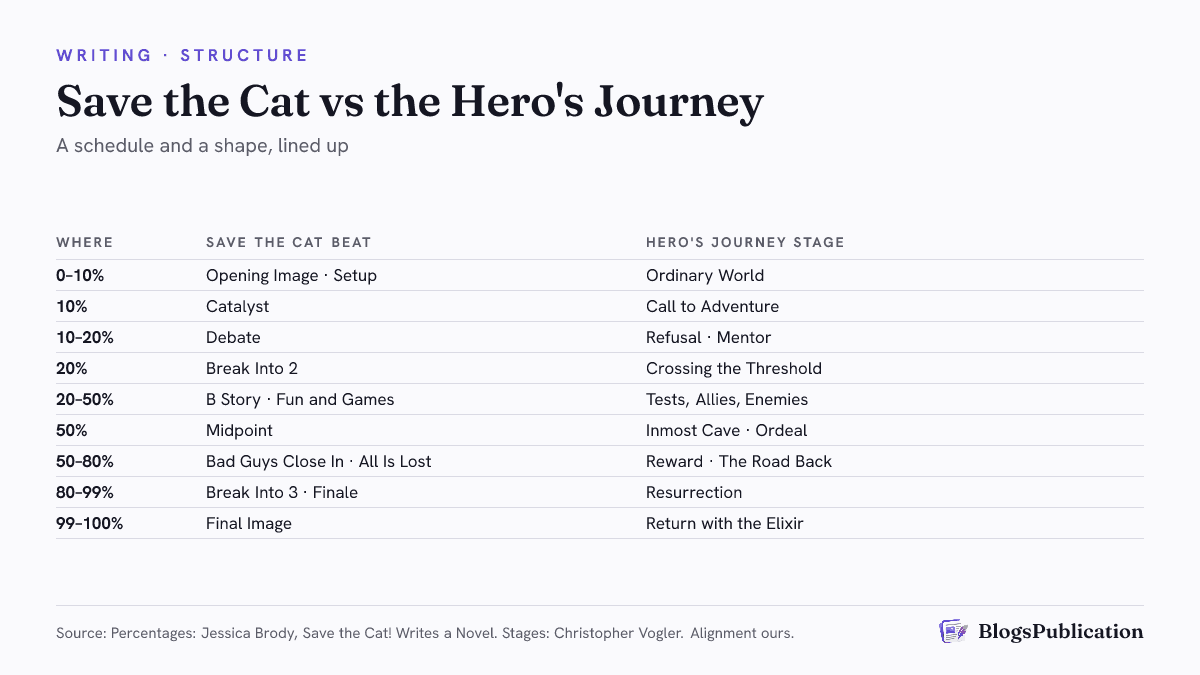
Use Save the Cat if you want to know where things should happen. Use the Hero's Journey if you want to know what has to happen to your hero. Save the Cat is a schedule: fifteen beats, each pinned to a point in the book. The Hero's Journey is a shape: a hero leaves a familiar world, is tested, and comes back changed, with no timing attached.
Because they answer different questions, they are not really rivals. Most of their beats line up, and a lot of working novelists use the Journey for shape and Save the Cat for timing. Below: where each comes from, the two laid side by side, one famous story mapped both ways, and a rule for choosing.
Key takeaways
- Save the Cat = a schedule. Fifteen beats; in Jessica Brody's novel version, Catalyst at 10%, Break Into 2 at 20%, Midpoint at 50%, All Is Lost at 75%, Break Into 3 at 80%.
- Hero's Journey = a shape. Twelve stages in Christopher Vogler's version, seventeen in Joseph Campbell's original. No percentages.
- They line up. Catalyst ≈ Call to Adventure; Break Into 2 ≈ Crossing the First Threshold; Finale ≈ Resurrection.
- Choose by problem: pacing problems want Save the Cat; "my hero doesn't change" problems want the Hero's Journey.
- Using both is normal: draft the Journey's stages, then pin them to Save the Cat's percentages.
Where each one comes from
The Hero's Journey started as scholarship, not writing advice. Joseph Campbell's The Hero with a Thousand Faces (1949) compared myths from around the world and described one pattern — the monomyth — in seventeen stages, grouped as Departure, Initiation and Return. Campbell was describing stories that already existed, not telling anyone how to write one.
The version writers use came later. Christopher Vogler, a Hollywood story consultant, condensed Campbell into twelve stages in a seven-page memo at Disney and then in his book The Writer's Journey: Ordinary World, Call to Adventure, Refusal of the Call, Meeting with the Mentor, Crossing the First Threshold, Tests, Allies and Enemies, Approach to the Inmost Cave, The Ordeal, Reward, The Road Back, The Resurrection, Return with the Elixir.
Save the Cat started as a screenwriting manual. Blake Snyder's Save the Cat! The Last Book on Screenwriting You'll Ever Need (2005) set out fifteen beats on the pages of a 110-page script — the Catalyst on page 12, the Midpoint on page 55 — and took its name from its rule that a hero should do something early on that makes the audience like them. Jessica Brody adapted it for novelists in Save the Cat! Writes a Novel (2018), turning the page numbers into percentages so the beats scale to any length.
So one is a scholar's description of myth, filtered through a story consultant; the other is a working screenwriter's schedule, adapted by a novelist. That difference explains almost everything else.
Side by side: where the beats and stages line up
The Hero's Journey has no percentages, so this alignment is approximate — but the correspondence is close enough to plan with. Percentages are Brody's.
| Where in the book | Save the Cat beat | Hero's Journey stage (Vogler) |
|---|---|---|
| 0–1% | Opening Image | Ordinary World |
| 1–10% | Setup (Theme Stated at 5%) | Ordinary World |
| 10% | Catalyst | Call to Adventure |
| 10–20% | Debate | Refusal of the Call; Meeting with the Mentor |
| 20% | Break Into 2 | Crossing the First Threshold |
| 22% | B Story | Tests, Allies and Enemies (the allies) |
| 20–50% | Fun and Games | Tests, Allies and Enemies |
| 50% | Midpoint | Approach to the Inmost Cave; The Ordeal |
| 50–75% | Bad Guys Close In | Reward; The Road Back |
| 75% | All Is Lost | The Road Back |
| 75–80% | Dark Night of the Soul | — |
| 80% | Break Into 3 | — |
| 80–99% | Finale | The Resurrection |
| 99–100% | Final Image | Return with the Elixir |
One placement varies more than the rest. In many stories the Ordeal is the midpoint crisis; in others it lands later, nearer the All Is Lost beat. Both are legitimate, and it is the main place where the two structures can pull a draft in different directions.
What each one has that the other doesn't
Save the Cat's extras are about the inside of the story. Theme Stated (5%) asks someone to voice, usually without knowing it, the lesson the hero will learn. Dark Night of the Soul (75–80%) is a beat of pure reaction — the hero absorbing the loss before finding the way forward. The Journey has no stage for either, and drafts built only on the Journey often rush from the low point straight into the climax.
The Hero's Journey's extras are about the people and the return. Meeting with the Mentor makes a guide figure a structural requirement, where Save the Cat folds mentors into its B Story. And Return with the Elixir insists the hero brings something back to the world they left — a cure, a truth, a changed self. Save the Cat's Final Image mirrors the opening image, which shows change; the Elixir asks what that change is for.
One story, both ways: Star Wars (1977)
Star Wars is the standard example for both structures, with good reason. George Lucas has said he structured it with the hero's journey in mind, and Campbell himself agreed in conversation with Bill Moyers that the trash-compactor scene is a strong example of his "Belly of the Whale" stage.
As a Hero's Journey:
- Ordinary World: Luke on his uncle's moisture farm on Tatooine, wanting to leave.
- Call to Adventure: Leia's message, hidden in R2-D2: "Help me, Obi-Wan Kenobi."
- Meeting with the Mentor: Obi-Wan gives Luke his father's lightsaber and tells him about the Force.
- Refusal of the Call: Luke says he can't go to Alderaan — there is work on the farm.
- Crossing the First Threshold: his aunt and uncle are killed; Luke leaves Tatooine on the Millennium Falcon.
- Tests, Allies and Enemies: the Mos Eisley cantina, Han Solo and Chewbacca, lightsaber training on the Falcon.
- Approach to the Inmost Cave: the Falcon is pulled into the Death Star.
- The Ordeal: rescuing Leia, and the trash compactor.
- Reward: escaping with Leia and the Death Star plans.
- The Road Back: Obi-Wan is gone; the plans reach the rebels; Han takes his money and leaves.
- The Resurrection: the trench run — Luke switches off his targeting computer and trusts the Force.
- Return with the Elixir: the Death Star destroyed, the medal ceremony.
Notice steps 3 and 4: Luke meets his mentor before he refuses the call, the reverse of Vogler's order. The Journey's stages are a checklist of what must happen, not a fixed sequence, which is part of what makes it flexible.
On a Save the Cat beat sheet:
- Opening Image: a small rebel ship overpowered by a Star Destroyer.
- Catalyst: Luke finds Leia's message. Debate: he tells Obi-Wan he can't leave the farm.
- Break Into 2: after his family is killed, Luke chooses to go.
- B Story: Han Solo, the cynic whose arc runs alongside Luke's.
- Fun and Games: Mos Eisley, the escape, the training.
- Midpoint: Alderaan is gone and the Falcon is captured — the stakes jump.
- Bad Guys Close In: the rescue goes wrong; the trash compactor.
- All Is Lost: Obi-Wan is killed by Vader — what Snyder calls the "whiff of death".
- Dark Night of the Soul: Luke grieves as they escape.
- Break Into 3: the plans reveal a weakness, and the attack is planned.
- Finale: the trench run. Final Image: the medal ceremony — the hunted rebels of the opening image now victorious.
Same film, same events. The Journey tells you why the trench run matters — it is Luke's resurrection as someone who trusts the Force. Save the Cat tells you when Obi-Wan has to die.
Choose Save the Cat if…
- You write commercial fiction — thriller, romance, mystery, young adult — where readers expect turns at familiar points.
- Your problem is pacing: the last draft's first act ate a third of the book, or the middle sags.
- You like numbers. Twenty percent of 90,000 words is 18,000; you can check on any given day whether the first act has overrun.
- You want a revision tool. Mark where each beat actually falls in a finished draft and the problems show up as gaps.
Choose the Hero's Journey if…
- Your hero physically leaves a familiar world and returns — quest fantasy, portal fantasy, adventure, coming-of-age.
- Your problem is change: beta readers say the hero is the same person at the end, or the ending feels hollow.
- You are a discovery writer. Twelve stages with no timing give direction without a schedule.
- You want to check your supporting cast — mentor, allies, threshold guardians — has a job to do.
Using both on one book
The combination is simple: draft the twelve stages to decide what happens, then use the table above to decide when. For a 90,000-word fantasy:
| Stage (beat) | Lands by |
|---|---|
| Call to Adventure (Catalyst) | ~9,000 words (10%) |
| Crossing the First Threshold (Break Into 2) | ~18,000 words (20%) |
| The Ordeal (Midpoint) | ~45,000 words (50%) |
| The Road Back (All Is Lost) | ~67,500 words (75%) |
| The Resurrection (Finale) | from ~72,000 words (80%) |
| Return with the Elixir (Final Image) | the last ~900 words |
If the Threshold is still out of reach at 30,000 words, you know before the draft is finished, not after. Romantasy adds a full romance arc on the same clock; how to outline a romantasy works through where the two interlock.
Where each one breaks
Save the Cat breaks when it becomes a form to fill in. The beats describe where energy changes, not what happens, but followed slavishly they produce books that feel assembled. It was built for screenplays, and quieter literary fiction often resists its percentages. Discovery writers who hate planning can still use it — as a diagnostic on a finished draft.
The Hero's Journey breaks when nobody goes anywhere. It assumes a departure and a return, and a domestic drama or an office novel strains against stages like Crossing the First Threshold. Campbell was also describing the myths he studied, with stages named "The Meeting with the Goddess" and "Woman as the Temptress"; Vogler's twelve drop those names, and later writers have proposed alternatives, such as Maureen Murdock's The Heroine's Journey.
If neither fits, that is information too. A book that opens in trouble and never stops escalating may be a Fichtean Curve, and the full comparison of eight story structures covers the rest, including Seven-Point for thrillers and the Story Circle for memoir.
The short version
| If… | Use |
|---|---|
| Your problem is pacing | Save the Cat |
| Your problem is that the hero doesn't change | Hero's Journey |
| Your hero leaves home and comes back | Hero's Journey for shape, Save the Cat for timing |
| You write commercial genre fiction | Save the Cat |
| You discover the story as you draft | Hero's Journey while drafting, Save the Cat in revision |
Whichever you choose, choose in an afternoon. A structure helps by telling you what the next scene is for, and that benefit arrives the moment you pick one. Once it is picked, our book outline templates guide compares ready-made sheets for both, and the nine stages of writing a book covers what comes after the outline. More guides are in the writing hub.
Sources: Joseph Campbell, The Hero with a Thousand Faces (1949); Christopher Vogler, The Writer's Journey; Blake Snyder, Save the Cat! The Last Book on Screenwriting You'll Ever Need (2005); Jessica Brody, Save the Cat! Writes a Novel (2018) and her beat sheet guide, the source of the percentages above; Wikipedia — Hero's journey for Campbell's and Vogler's stage lists and Lucas's and Campbell's comments on Star Wars; Wikipedia — Save the Cat! for Snyder's page numbers. The alignment table and both Star Wars mappings are our own analysis.
FAQ
Frequently asked questions
What is the difference between Save the Cat and the Hero's Journey?
Save the Cat is a schedule: fifteen beats, each pinned to a point in the book — in Jessica Brody's novel version, the Catalyst at 10%, the Midpoint at 50%, All Is Lost at 75%. The Hero's Journey is a shape: a sequence of stages in which a hero leaves a familiar world, is tested, and comes back changed, with no timing attached. Save the Cat answers 'where should this happen?'; the Hero's Journey answers 'what has to happen to my hero?'.
Which is better for fantasy, Save the Cat or the Hero's Journey?
For a quest or portal fantasy, where the hero physically leaves home and returns, the Hero's Journey fits the shape of the story better. Many fantasy writers then use Save the Cat's percentages to time those stages, because the Journey gives no guidance on pacing and fantasy first acts are prone to running long.
How many beats does Save the Cat have, and how many stages does the Hero's Journey have?
Save the Cat has fifteen beats, in both Blake Snyder's screenwriting book and Jessica Brody's novel adaptation. The Hero's Journey has seventeen stages in Joseph Campbell's original, The Hero with a Thousand Faces (1949), and twelve in Christopher Vogler's version for writers, which is the one most writing guides use.
Can I use Save the Cat for a novel? Wasn't it written for screenplays?
Blake Snyder wrote it for screenwriters in 2005, with beats placed on page numbers of a 110-page script. Jessica Brody adapted it for novelists in Save the Cat! Writes a Novel (2018), replacing the page numbers with percentages of the finished book, so the same beats scale to any length.
Do I have to hit the Save the Cat percentages exactly?
No. They are targets for a finished draft, and published books drift from them by several percent. They are most useful in revision: if your Catalyst arrives at 25% instead of around 10%, the opening probably needs cutting or restructuring.
Is Star Wars a Hero's Journey?
Yes, deliberately. George Lucas has said Star Wars was structured with the hero's journey in mind, and Joseph Campbell agreed in conversation with Bill Moyers that the trash-compactor scene is a strong example of his 'Belly of the Whale' stage. It also maps cleanly onto Save the Cat's beats, which is why it is the standard example for both.
Written by
The BlogsPublication Team
EditorBlogsPublication is researched, written, and edited by a small team. We work from primary sources and link to them, a human editor is responsible for everything we publish, and we note substantive corrections on the article itself. Where AI tools help with research or drafting, a person still verifies the result before it runs.
BlogsPublication reporting is guided by our editorial standards.
The newsletter
Good writing, once a week.
Our best essays and reporting, delivered to your inbox. No noise, unsubscribe anytime.
Comments
No comments yet. Be the first to share your thoughts.
Keep reading
Related articles
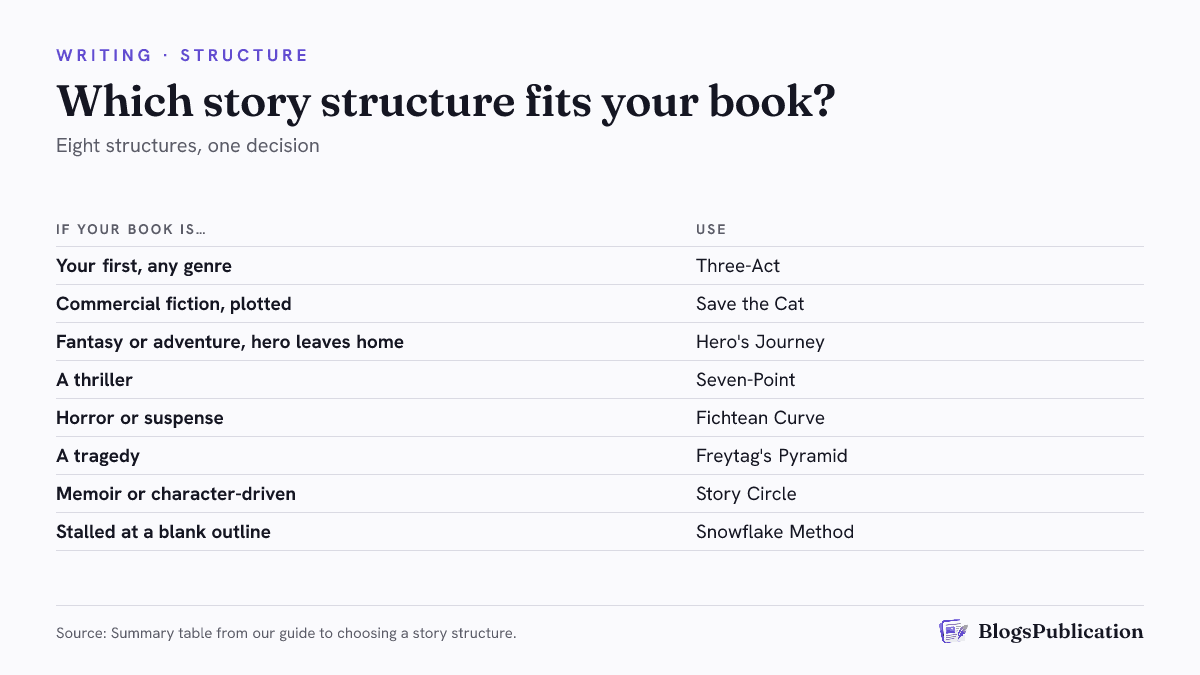
Save the Cat vs Hero's Journey vs Seven-Point: Which Story Structure Should You Actually Use?
Eight story structures, one decision. They are not rivals describing different stories — they are different resolutions of the same photograph, and the right one depends on how you write, not on which book you read last.
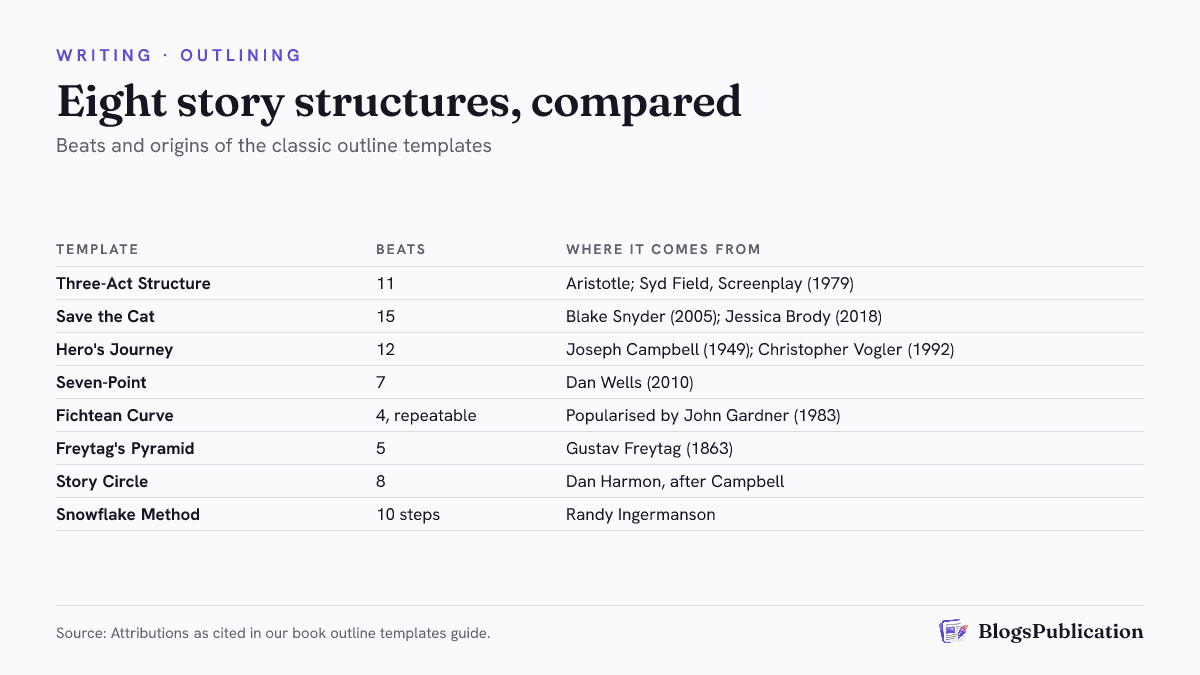
17 Book Outline Templates, Compared: Which One Fits the Book You're Actually Writing
Eight story structures and nine genre starter kits, with the beats, the word targets, the attributions — and, unusually, an honest note on when each one is the wrong tool. A working guide to outlining, not a listicle of names.
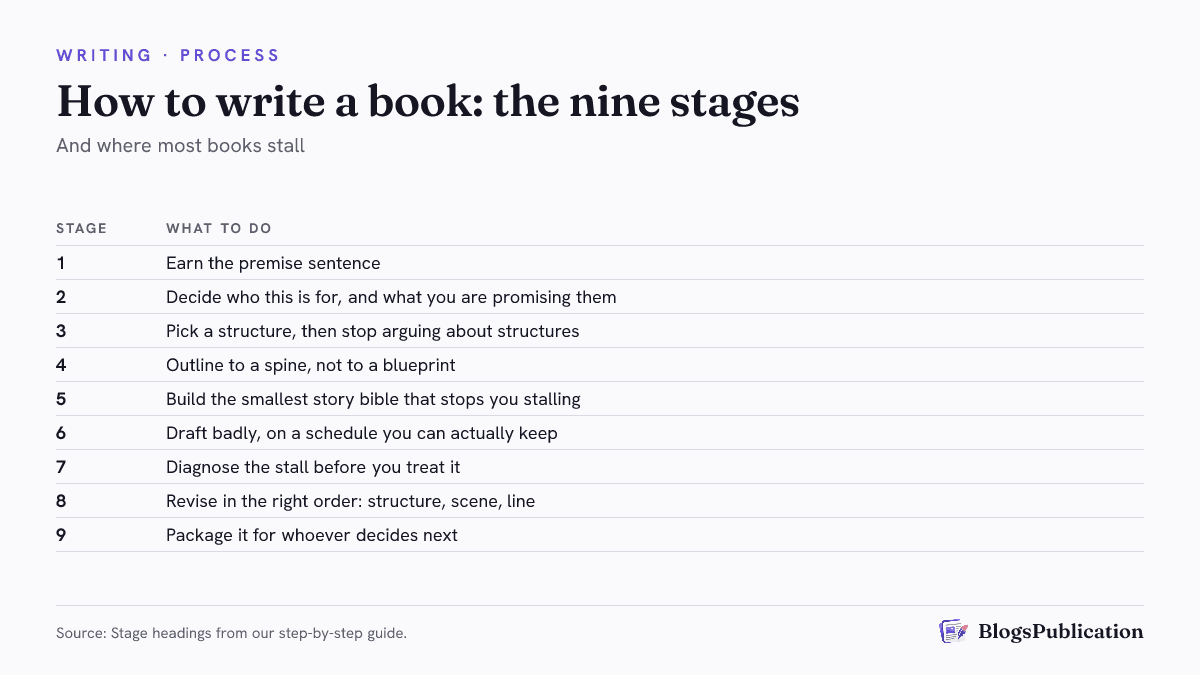
How to Write a Book, Step by Step: The Nine Stages That Actually Finish One
Most 'how to write a book' advice is a list of tips in no particular order. Finishing is a sequence problem: nine stages, each with a decision that has to be made before the next one is survivable. Here is the whole sequence, with the failure mode at every step.
The Fichtean Curve: What It Is, Three Examples, and a Template
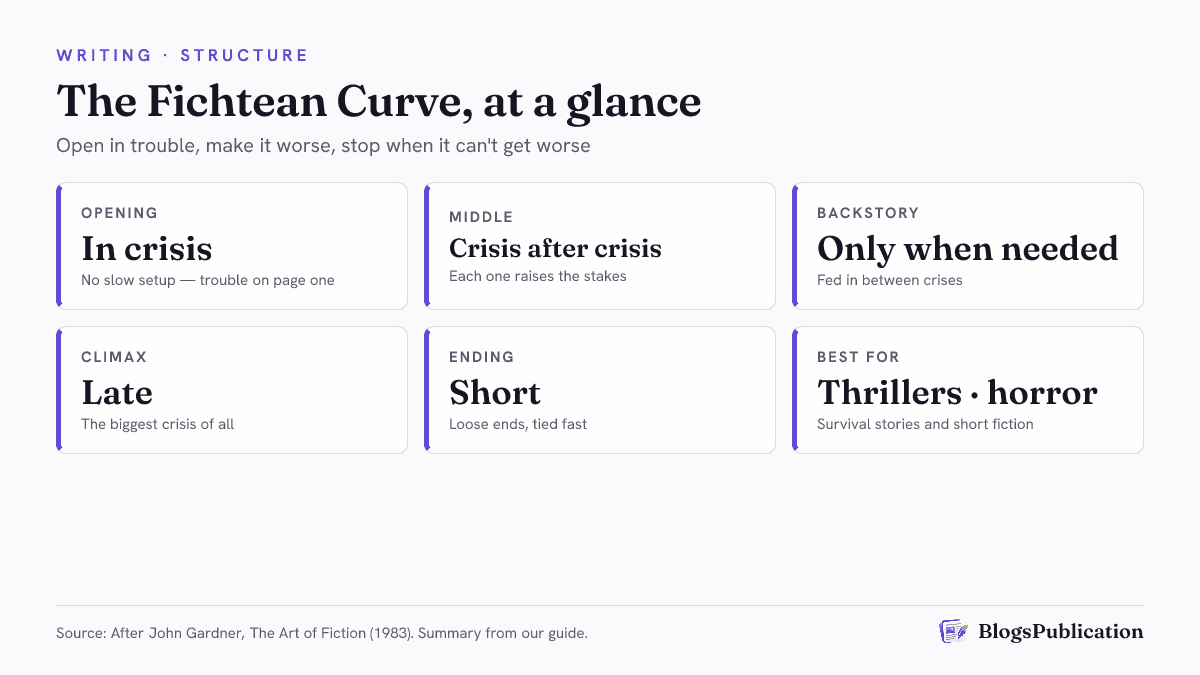
The Fichtean Curve skips the slow setup: open in trouble, escalate through a series of crises, peak late, resolve fast, and feed in backstory only when the reader needs it. Where it comes from, The Hunger Games, Jaws and The Martian mapped to it, and a fill-in template.