
The Fichtean Curve: What It Is, Three Examples, and a Template
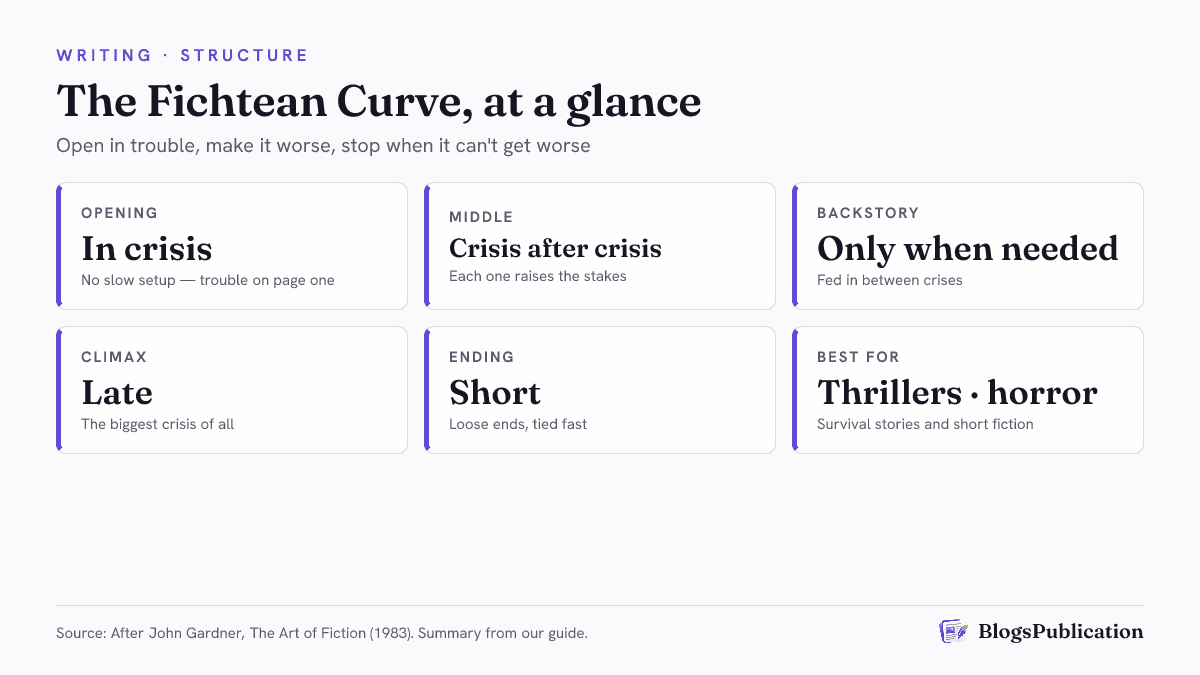
The Fichtean Curve is a plot structure that skips the slow setup. The story opens in trouble, climbs through a series of crises that each raise the stakes, peaks at a climax late in the book, and then resolves quickly. Backstory is not front-loaded; it arrives between crises, only when the reader needs it to understand what happens next.
The novelist John Gardner described it in The Art of Fiction (1983), and you have read dozens of books built on it whether or not anyone named it. Here is what the shape looks like, where it comes from, three well-known stories mapped to it, when to use it — and when not to — and a template you can fill in tonight.
Key takeaways
- Open in crisis. No chapter of normal life before the trouble starts.
- Escalate crisis by crisis. Each one is worse, costlier or more urgent than the last, and partial fixes never return the story to calm.
- Backstory only when needed, slipped in between crises.
- Late climax, short ending. Most of the book is rising action; the falling action is brief.
- Best for thrillers, horror, survival stories and short fiction. Worst for books whose power depends on a peaceful world the reader has time to love.
What the Fichtean Curve looks like
Draw a line that starts already off the ground and climbs to the right in a jagged sawtooth. Each peak is a crisis. After each one the line dips a little — the protagonist survives, regroups, learns something — but it never falls back to where it started, and the next peak is higher. Near the end comes the highest peak, the climax, and then a short drop to the finish.
That gives three parts:
- Rising action, made of a series of crises. This is most of the book.
- The climax, the last and largest crisis.
- Falling action, short: loose ends tied, the new normal glimpsed.
The two things that make it Fichtean rather than just "a plot with conflict" are the missing setup — the first page is already a problem — and the delivery of backstory in passing. The reader learns the world while running through it.
Where it comes from
Gardner set the curve out in The Art of Fiction: Notes on Craft for Young Writers, published in 1983, the year after his death. The book was written for students, and the curve was meant to be simple: a shape to keep in mind, not a list of named beats. The name is usually explained as a nod to the German philosopher Johann Gottlieb Fichte.
That simplicity is the point. Save the Cat gives you fifteen beats with percentages; the Hero's Journey gives you twelve stages. The Fichtean Curve gives you one instruction: make it worse, then make it worse again, and do not stop to explain unless the reader needs it.
Three examples, mapped
The Hunger Games (Suzanne Collins, 2008)
- Opening crisis: reaping day. Within the first two chapters Prim's name is drawn and Katniss volunteers to take her place. There is no chapter of ordinary life before the trouble.
- Backstory, as needed: when Peeta's name is drawn, the story breaks into the memory of the day he threw Katniss burnt bread while her family was starving. The reader gets it exactly when it is needed to understand their relationship.
- Crises: Peeta's public confession of love at the interviews; the bloodbath at the Cornucopia; being hunted by the Careers, with Peeta apparently among them; the wall of fire the Gamemakers send; the tracker jackers; Rue's death; the rule change that lets two tributes from one district win; Peeta's infected wound and the feast; the mutts and Cato; the rule change reversed.
- Climax: the berries.
- Falling action: a few chapters of aftermath, short next to the climb.
Jaws (Steven Spielberg, 1975)
- Opening crisis: a night swim, and the first death, within minutes.
- Crises: Brody wants to close the beaches and the mayor refuses; a boy is killed on a crowded beach; a bounty brings a frenzy of amateur hunters; a tiger shark is caught and declared the killer — a false resolution; Hooper and Brody find a fisherman's wrecked boat; the Fourth of July attack in the estuary, near Brody's son; the hunt on the Orca, the barrels, the boat breaking apart, Quint's death.
- Backstory, as needed: Quint's USS Indianapolis speech arrives late, on the boat, the night before the final attack. It explains his obsession at the exact moment it matters, and not a minute earlier.
- Climax: Brody and the air tank.
- Falling action: two men paddling back to shore, in barely a couple of minutes.
The Martian (Andy Weir, 2011)
- Opening crisis: Mark Watney is alone on Mars, left for dead after his crew evacuated in a storm. The first log entry is the problem.
- Crises: food, solved by growing potatoes inside the Hab; water, made from rocket fuel, which nearly turns the Hab into a bomb; contact with Earth, by digging up an old probe; the Hab's airlock blowing out and killing his crop; the resupply rocket lost at launch; the long rover drive across Mars, and a dust storm on the way; a stripped-down launch to meet his crew in orbit.
- Backstory, as needed: delivered through log entries and short cutaways to Earth and the ship, each time a problem requires it.
- Climax: the intercept in orbit.
- Falling action: short, as soon as he is safe.
Notice what all three share. None opens with normal life. Each crisis changes the situation rather than repeating the last one: a new kind of threat, a higher cost, a narrower window. And each saves its most important piece of backstory for the moment it pays off.
Fichtean Curve vs Three-Act vs Freytag's Pyramid
| Fichtean Curve | Three-Act | Freytag's Pyramid | |
|---|---|---|---|
| Opening | In crisis | Setup, then disruption | Exposition |
| Middle | A series of escalating crises | Complications and a midpoint turn | Rising action to a central peak |
| Climax | Late | Late | In the middle |
| Ending | Short | Resolution | Long falling action |
| Backstory | Between crises, when needed | Often in the setup | In the exposition |
| Best for | Thrillers, horror, survival, short stories | First books, most genres | Tragedy |
If you have been told your first chapters are slow, this table is the diagnosis. Often the book is Fichtean and was written as Three-Act — the setup is a story the reader does not need yet. The full comparison of eight story structures covers the others.
When to use it
- Thrillers, horror, suspense and survival stories, where dread and momentum are the product.
- Mysteries that open with a body. The investigation is a series of crises by design.
- Short stories, which have no room for a long setup.
- Discovery writing. You need an opening crisis and a direction of travel, not a beat sheet. You can find the individual crises while drafting.
- Revision, when beta readers say the opening drags: try cutting to the first crisis and see what the reader actually misses.
When not to use it
- When the ending depends on loss. A reader cannot mourn a world they never saw at peace. If your climax is meant to cost the protagonist their home, their family or their innocence, the book usually needs time with those things first — a setup the Fichtean Curve refuses.
- When the world needs room. Epic fantasy and complex science fiction can be told this way, but feeding a large world entirely through crises is hard, and readers can drown.
- When every crisis feels the same. The commonest failure is crisis inflation: a chase, then another chase, then a bigger chase. Escalation means the stakes or the kind of threat change, not just the volume. Give the reader short dips between peaks, too; a book that never breathes stops feeling tense.
How to plan a Fichtean Curve: a fill-in template
Copy this table into whatever you write in. Fill in the opening crisis and the climax first, then the crises between, and check that each row is worse than the one above it.
| # | What goes wrong | What the protagonist tries | What it costs | Backstory revealed here | Stakes now |
|---|---|---|---|---|---|
| Opening crisis | |||||
| Crisis 1 | |||||
| Crisis 2 | |||||
| Crisis 3 | |||||
| Crisis 4 | |||||
| Crisis 5 | |||||
| Climax | |||||
| Falling action |
Three rules make the template work:
- Each crisis must change something — a new threat, a lost resource, a broken relationship, a shorter clock. If you could swap two crises without anyone noticing, one of them is filler.
- Each crisis should leave the protagonist worse placed for the next one, even when they win it. Partial victories with a price keep the line climbing.
- Put each piece of backstory next to the crisis that needs it. If a fact from the past explains a choice in crisis 4, reveal it in or just before crisis 4. Then cut anything left over from your opening.
Once the crises are down, check the two places Fichtean drafts most often go wrong: the first page (is it really a problem, or a problem approaching?) and the dips (does the reader get a breath between peaks?). If you plan in percentages instead, Save the Cat vs the Hero's Journey compares the two most popular beat-based structures, and our guide to book outline templates compares ready-made sheets. More craft guides are in the writing hub.
Sources: John Gardner, The Art of Fiction: Notes on Craft for Young Writers (1983); Gustav Freytag, Technique of the Drama (1863); the novels The Hunger Games (Suzanne Collins, 2008) and The Martian (Andy Weir, 2011), and the film Jaws (Steven Spielberg, 1975). The three mappings are our own analysis.
FAQ
Frequently asked questions
What is the Fichtean Curve?
A plot structure in which the story opens in crisis rather than with a setup, climbs through a series of crises that each raise the stakes, peaks at a late climax, and ends with a short falling action. Backstory is not front-loaded; it is fed in between crises, only when the reader needs it. The novelist John Gardner described it in The Art of Fiction (1983).
Who came up with the Fichtean Curve?
John Gardner, the American novelist and teacher, set it out in The Art of Fiction: Notes on Craft for Young Writers, published in 1983, the year after his death. The name is usually explained as a nod to the German philosopher Johann Gottlieb Fichte.
What is the difference between the Fichtean Curve and Freytag's Pyramid?
Freytag's Pyramid (1863) starts with exposition, puts the climax in the middle and gives the falling action as much room as the rising action, which suits tragedy. The Fichtean Curve skips the exposition, puts the climax late and keeps the falling action short, which suits thrillers, horror and survival stories.
How many crises does a Fichtean Curve need?
There is no fixed number. Descriptions of the structure ask for at least two or three in the rising action; a novel usually has many more, while a short story may have only two. What matters is that each crisis changes the situation and raises the stakes, rather than repeating the last one.
Is the Fichtean Curve good for short stories?
Yes, it is one of the best fits. A short story has no room for a long setup, and the Fichtean Curve's habit of starting in trouble and delivering backstory in passing suits the form. It is also popular with novelists in thriller, horror, mystery and survival fiction.
Can I use the Fichtean Curve without outlining?
Largely, yes. It specifies less than most structures: you need an opening crisis, a sense that each crisis should be worse than the last, and an idea of the climax. That makes it a common choice for discovery writers, who can find the individual crises while drafting.
Written by
The BlogsPublication Team
EditorBlogsPublication is researched, written, and edited by a small team. We work from primary sources and link to them, a human editor is responsible for everything we publish, and we note substantive corrections on the article itself. Where AI tools help with research or drafting, a person still verifies the result before it runs.
BlogsPublication reporting is guided by our editorial standards.
The newsletter
Good writing, once a week.
Our best essays and reporting, delivered to your inbox. No noise, unsubscribe anytime.
Comments
No comments yet. Be the first to share your thoughts.
Keep reading
Related articles
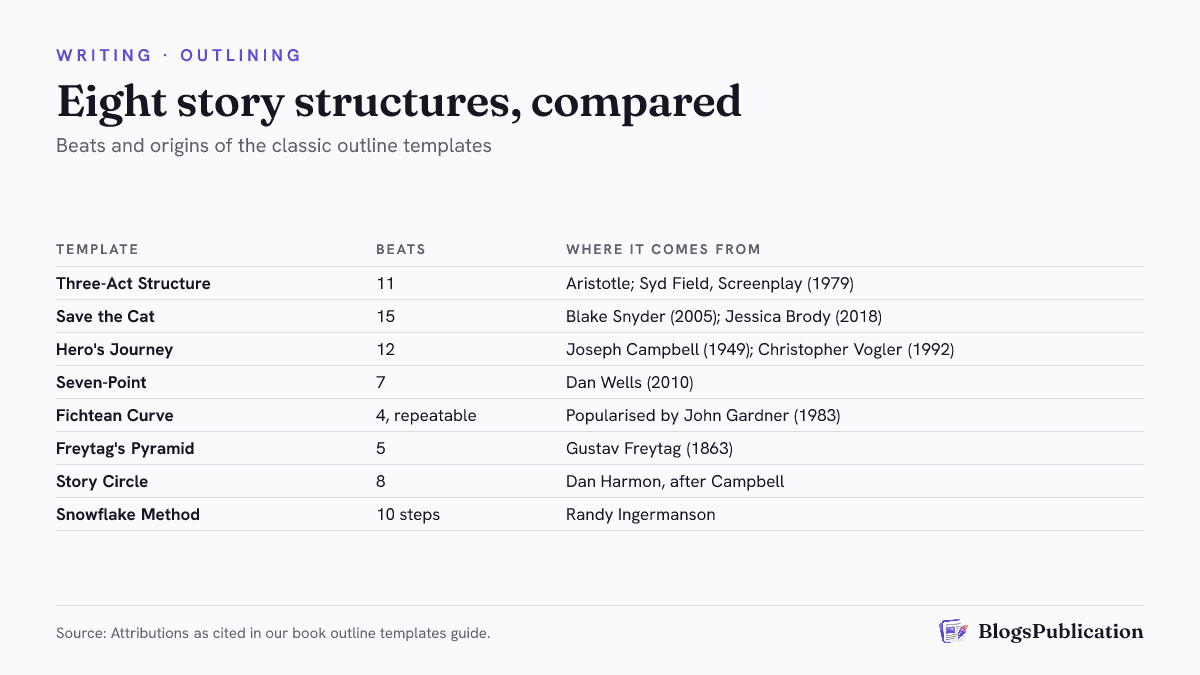
17 Book Outline Templates, Compared: Which One Fits the Book You're Actually Writing
Eight story structures and nine genre starter kits, with the beats, the word targets, the attributions — and, unusually, an honest note on when each one is the wrong tool. A working guide to outlining, not a listicle of names.
The AI Writing Coach That Diagnoses First, Then Teaches
Most writing advice fails not because it is wrong, but because it arrives out of order, undiagnosed and ungraded. CipherWrite's AI Writing Coach is built around those three gaps — and around a fixed catalogue of 32 craft modules the model is not allowed to invent around.
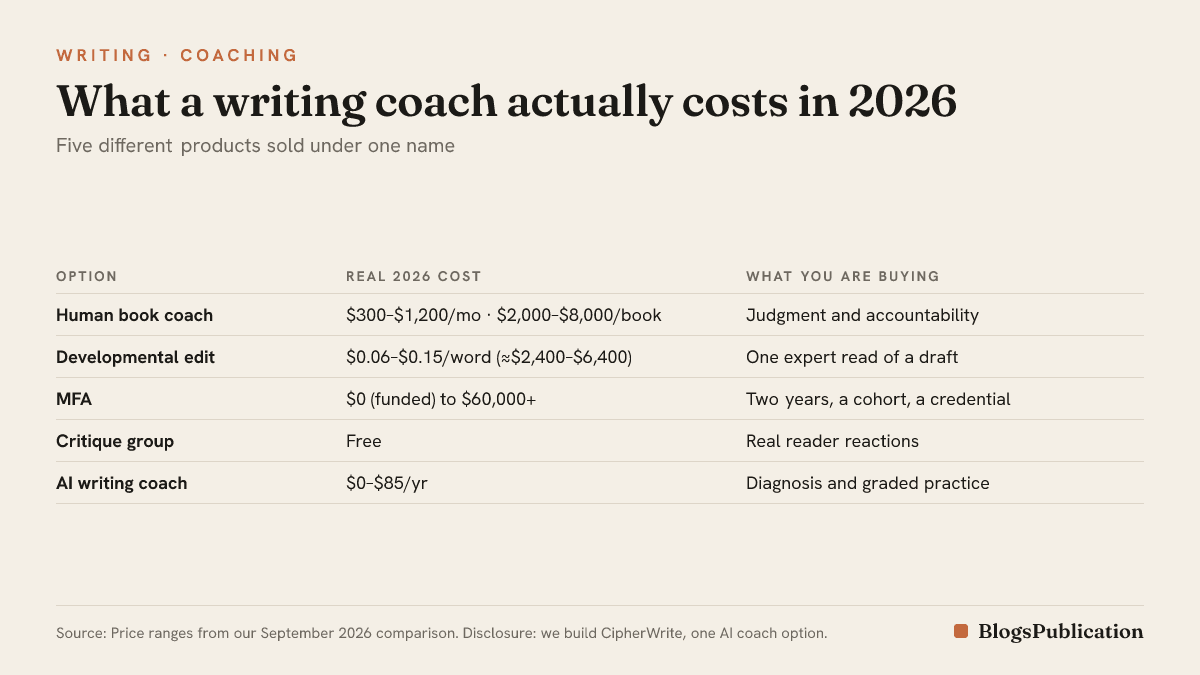
What a Writing Coach Actually Costs in 2026 — and What Each Kind Buys You
A human book coach, an MFA, a critique group, a shelf of craft books and an AI writing coach are five different products sold under one word. They cost between nothing and $60,000, and they fail in completely different ways. Here is what each one is actually for.
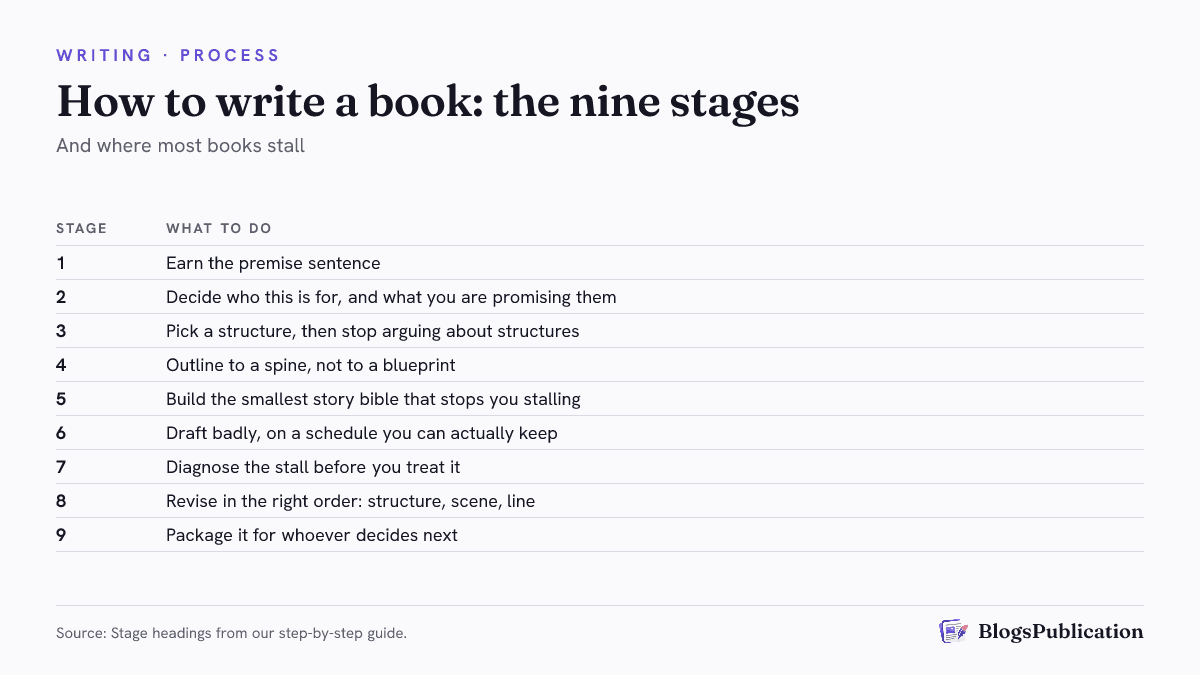
How to Write a Book, Step by Step: The Nine Stages That Actually Finish One
Most 'how to write a book' advice is a list of tips in no particular order. Finishing is a sequence problem: nine stages, each with a decision that has to be made before the next one is survivable. Here is the whole sequence, with the failure mode at every step.