
NaNoWriMo Is Gone. CipherWrite Seasons Rebuilds It for Every Month of the Year
Disclosure: we build CipherWrite. CipherWrite is not affiliated with National Novel Writing Month. The section on what Seasons doesn't replace is there because some of you will be better served elsewhere.
For a quarter of a century, November meant one thing to a few hundred thousand people: 50,000 words of a novel in 30 days. National Novel Writing Month made that challenge famous. Then, on 31 March 2025, the nonprofit that ran it shut down.
The challenge outlived the organisation. This November there are several free events to choose from, and we compared them in our guide to NaNoWriMo in 2026. This article is about one of them, and about a different question: what did NaNoWriMo actually run on, and can it be rebuilt?
CipherWrite Seasons is the most complete attempt we know of. It brings back the parts that made people finish: the goal, the deadline, the count, and the small group going through it with you. It then does two things NaNoWriMo never did. It runs every month, and it is built so that nobody can read your pages, including CipherWrite.
Key takeaways
- NaNoWriMo closed on 31 March 2025. Its forums, buddy lists, word-count tools and Camp sessions closed with it.
- CipherWrite Seasons is a free monthly challenge. The November Season runs 1–30 November 2026, and enrolment is open until 24 November.
- Pick the classic 50,000 words or your own goal in words, focused minutes or days written.
- You are matched into a cabin of up to six writers whose goals are a similar size. They see your progress, never your pages.
- A daily check-in email does the maths: your count, and the smallest daily number that still gets you to your goal.
- It runs every month, with lighter Camp editions in April and July. Miss November and the next Season starts on 1 December, not next year.
- It doesn't rebuild everything. No forums, no regional write-ins, no author pep talks, no certificate, and you write in CipherWrite's editor.
What NaNoWriMo actually was
Chris Baty started National Novel Writing Month in July 1999 with 21 participants in the San Francisco Bay Area. It moved to November in 2000 and grew into one of the largest writing events in the world: 431,626 participants in 2015, and more than 400,000 in 2022, according to the organisation's own figures as compiled on Wikipedia.
From the outside it looked like a single rule. From the inside it was a set of parts that worked together:
- A goal everyone shared: 50,000 words, about 1,667 a day.
- A hard deadline: 11:59pm on 30 November.
- A count other people could see, updated as you went.
- Buddies: writers you added, whose counts sat next to yours.
- Proof and a prize: for most of its history, winners could have their word count verified and print a winner's certificate.
- Pep talks from well-known authors, sent through the month.
- Forums and regions. Volunteer Municipal Liaisons ran local forums, kickoff parties and in-person write-ins.
- Camp NaNoWriMo, from 2011, which ran in April and July from 2013 onward. Writers set their own goals and joined "cabins" with their own message boards.
- A Young Writers Program for classrooms, from 2004.
What made people finish was not any one of these. It was the combination: a number you had promised, a date you couldn't move, and a few people who would notice if you stopped.
Why it ended
NaNoWriMo's last two years brought two crises. Its forums were put into read-only mode after allegations that moderators had groomed minors, and staff were criticised for acting slowly. Then, in September 2024, it published a statement saying that "the categorical condemnation of Artificial Intelligence has classist and ableist undertones." Writers resigned from its boards, and the writing platform Ellipsus withdrew as a sponsor.
On 31 March 2025, director Kilby Blades announced the closure in a YouTube video, citing the organisation's finances. Camp NaNoWriMo ended with it. Our NaNoWriMo 2026 guide has the full story and its sources.
What CipherWrite Seasons is
A Season is a writing challenge that lasts one calendar month. In CipherWrite's words, it is "a commitment to write toward a target inside one calendar month." Every month has one, starting on the 1st. April and July run as Camp editions, described as lighter months, in the slots Camp NaNoWriMo used to fill.
The November Season 2026 runs from 1 to 30 November, keeps the classic 50,000-word goal as the default, and is free, with no card needed.
How a Season works, step by step
-
Sign up free. No card.
-
Choose a goal. Five starting points, or set your own:
Goal What it takes in November 50,000 words 1,667 words a day, every day 30,000 words 1,000 words a day 10,000 words About 333 words a day 30 minutes a day 15 hours across the month Write on 20 days A day counts at 150 words or 10 focused minutes A custom goal can be set in words, minutes or days.
-
Write in the CipherWrite editor. Words are counted as you type or paste. The count is taken in your browser, and only the number leaves your device.
-
Get matched into a cabin of up to six writers. Goals are converted into rough daily effort, so a 50,000-word drafter can share a cabin with someone putting 30 hours into a revision. Cabins fill in the order people join, so early in the month yours may still be filling.
-
Get a daily check-in email at a time you choose. It shows your number, the smallest daily figure that still gets you to your goal, and how many of your cabin wrote yesterday. It skips days you have already written.
-
Finish. A "Finished" mark appears next to your pen name in the cabin.
Cabinmates can send each other reactions, chosen from six preset ones such as "I see you" and "keep going," up to ten a day.
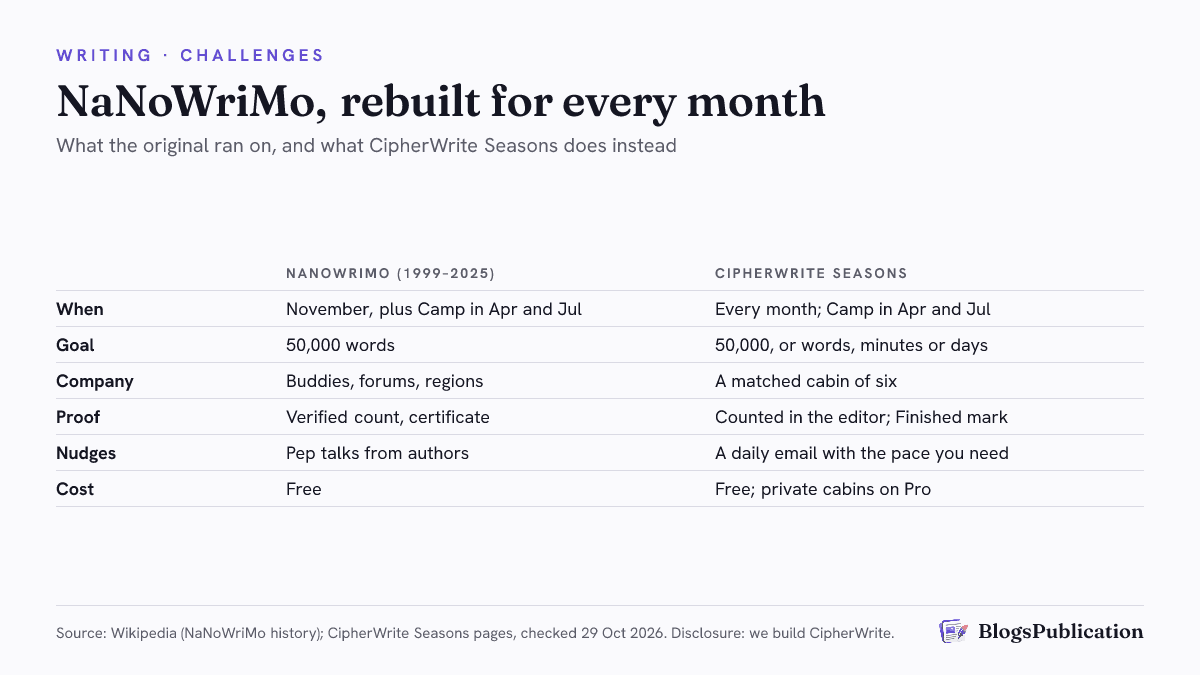
NaNoWriMo's parts, and what Seasons does instead
| NaNoWriMo had | CipherWrite Seasons does |
|---|---|
| One challenge a year, plus Camp in April and July | A Season every month, with Camp editions in April and July |
| One goal: 50,000 words | 50,000 words, or your own goal in words, minutes or days |
| Buddies you added | A matched cabin of up to six, or a private cabin for people you know |
| A count on your profile | A count in your cabin, ranked by progress toward your own goal |
| Pep-talk emails from authors | A daily check-in email with your number and the pace you need |
| Word-count verification and a certificate | Counting in the editor as you write, and a "Finished" mark |
| Forums and regional write-ins | Not rebuilt |
| Free | Free; private cabins need a paid plan, and invitees join free |
Where Seasons improves on the original
It runs every month
This is the change that matters most. NaNoWriMo was a once-a-year event. If you started on 1 November and stalled by the 9th, the next real attempt was eleven months away. Camp helped, but only twice more a year.
Seasons restarts on the 1st of every month. As CipherWrite puts it, falling off "costs you a fortnight, not a year." A writer who loses November to a family emergency starts again on 1 December with a new goal and a new cabin, instead of carrying a failure until next autumn.
It lets you pick a goal you can actually measure
50,000 words is a fine goal for a first draft of a short novel. It is the wrong goal for a revision month, a month with a new baby, or a writer whose problem is showing up at all.
Seasons offers three kinds of goal, chosen because they can be measured rather than self-reported: words, focused minutes and days written. CipherWrite suggests the days-written goal for most people starting out, and a minutes goal for revision, where the word count often goes down on a good day. That fixes a real flaw in the original. NaNoWriMo's single number made revision, editing and planning invisible.
Cabins are fair
Six writers is small on purpose. Big enough that someone notices when you don't write. Small enough that you know who they are.
The matching is the clever part. Cabins are grouped by the size of the month each writer has taken on, and standings rank everyone by progress toward their own goal, not raw word count. Someone writing 10,000 words is never sat at the bottom of a table beneath someone writing 50,000. A NaNoWriMo buddy list never made that adjustment.
Nobody reads your pages
NaNoWriMo never needed your manuscript, but it was built around sharing: project pages, forums, and Camp cabins where writers swapped excerpts. For a memoir about living people, or a book you would rather nobody saw yet, that was a risk you managed yourself.
Seasons is built the other way round. Cabinmates see exactly this: your pen name, goal, count, streak, the reactions you have received, and whether you wrote today or have finished. The word count is calculated in your browser, so only a number is sent. Chapters in encrypted projects are encrypted with a key held on your device, which CipherWrite doesn't have. In CipherWrite's words, the standings give no path to "a single sentence of your draft." Why that matters for unpublished work is worth a read if it hasn't come up for you before.
The email does the maths
Every NaNoWriMo veteran knows the feeling of being 4,000 words behind on the 12th and not knowing what that means. Seasons' check-in email tells you: the smallest daily number that still gets you there. On a 50,000-word goal, one missed day turns 1,667 a day into 1,724. Three missed days make it 1,852. That is behind, not over, and seeing the number makes it easier to believe.
There is no message board to moderate
Matched cabins have no chat and no message box, only the six preset reactions. That will feel thin to some writers (more on that below), but it is a deliberate choice. Strangers who can't message each other can't use the message box to harass or groom anyone. Given how NaNoWriMo's forums ended, that is a reasonable trade.
What Seasons doesn't replace
Some of what made NaNoWriMo special is not here, and it is better to know before you commit a month.
- No forums and no regional write-ins. If what you loved was the crowd, a café full of strangers typing, or a thread arguing about plot holes at midnight, Seasons doesn't offer it. Look for a local writing group, or a library programme.
- Small groups, not a crowd. Six writers is the point, but it is not the feeling of being one of 400,000. ProWritingAid's Novel November says it has 100,000 participants, with daily sprints, forums and more than 150 live workshops.
- No chat with strangers. Matched cabins only have reactions. Free-form chat exists only in a private cabin, which you set up and invite up to seven people into. The person who starts it needs a paid plan. That chat is ordinary stored text, not encrypted like your manuscript, and CipherWrite says so plainly.
- You can't pick your matched cabin. Matching is automatic. If you want specific people, that is what a private cabin is for.
- No certificate and no prizes. CipherWrite's page says it directly: "No certificate and no prizes." Reedsy's Novel Sprint offers $5,000, $2,500 and $1,000 prizes, each with a literary agent meeting.
- You write in CipherWrite's editor. The count comes from words typed or pasted there. If you draft in Scrivener or Word and don't want to move, Novel November reads your count from those apps.
- No pep talks from famous authors. The daily email is practical rather than inspirational.
- No stated rule on AI-generated text. The count is on your honour, as it largely was under NaNoWriMo. If you want a challenge that bans AI outright, Reedsy's does.
Seasons and the other November 2026 challenges
Checked against each organiser's page on 29 October 2026.
| CipherWrite Seasons | Novel November | Reedsy Novel Sprint | NaNo 2.0 | |
|---|---|---|---|---|
| Run by | CipherWrite | ProWritingAid | Reedsy | A community-led project |
| When | Every month; November is 1–30 Nov | 1–30 Nov | 1 Nov to 30 Nov, 11:59pm EST | November |
| Goal | 50,000 words or your own | 50,000 words | 50,000 new words | Your own goal |
| Where you write | CipherWrite's editor | Any app: Word, Scrivener, Google Docs | Reedsy Studio only, no pasting | Anywhere; log in its tracker |
| Company | A matched cabin of six | Sprints, forums, 150+ workshops | A contest | Badges, pep talks |
| AI | No stated rule | No ban stated | AI-generated text disqualifies | No stated rule |
| Privacy | Others see counts only; chapters encrypted on your device | Says your text is never sold, shared or used for training | Your draft lives in Reedsy Studio | Nobody reads your work unless you share it |
| Cost | Free; private cabins need Pro | Free account | Free account | Free |
Which one to pick:
- You want a big crowd and to keep using Scrivener or Word: Novel November.
- Prizes and a hard no-AI rule motivate you: Reedsy Novel Sprint.
- You want to track a goal with no company and no new app: NaNo 2.0.
- You want a small group that notices, a goal that fits your month, privacy, and another chance on 1 December: CipherWrite Seasons.
Nothing stops you combining them. Plenty of writers will track the same words in two places. For more options, including AI-free and revision challenges, see our ranking of the best NaNoWriMo alternatives for 2026.
How to make the most of a November Season
- Pick the goal you will hit, not the one you admire. If you have never finished a month, start with write on 20 days. Finishing a smaller goal builds the habit that a 50,000-word goal needs.
- Join early. Cabins fill in join order. Enrolment closes on 24 November, but a cabin that forms on 1 November has thirty days to get to know each other.
- Set the check-in email for when you can act on it. A 7am reminder is useless if you write at 10pm.
- Use the reactions. They are small, and that is the point. "I see you" on someone's bad day is most of what a writing buddy is for.
- Bring your old NaNo group. If you had buddies before 2025, a private cabin is the closest thing to getting them back. One person needs Pro, and everyone else joins free.
- Plan before the 1st. Three days is enough to write a one-line premise and the first ten scenes. Our story structure comparison and outline templates guide will get you there. The second week is where most drafts stall, and that is usually a structure problem, not a discipline problem.
- Treat 1 December as a new Season. 50,000 words is a real draft, but rarely a finished novel. Set December's goal for finishing, and January's in minutes for revision. Our nine stages of writing a book picks up where November leaves off.
The verdict
NaNoWriMo's genius was never the number. It was a promise, a deadline, and a few people who would notice if you stopped. CipherWrite Seasons rebuilds exactly that and fixes the original's biggest weakness: it doesn't make you wait a year to try again.
It is smaller than NaNoWriMo was, and it is meant to be. You won't find a forum of thousands or a café write-in. You will find up to five other writers on a similar month to yours, a daily number that tells you the truth, and a draft that nobody else can read. For most writers trying to finish a book, that is the part of NaNoWriMo that did the work.
Join the November Season on CipherWrite →
Checked on 29 October 2026: CipherWrite's November Season, monthly writing challenge, buddies and Camp pages; ProWritingAid — Novel November; Reedsy — Novel Sprint 2026; NaNo 2.0. NaNoWriMo's history: National Novel Writing Month on Wikipedia and Literary Hub, 1 April 2025. Event details change; check each organiser's page before you sign up.
FAQ
Frequently asked questions
What is CipherWrite Seasons?
Seasons is CipherWrite's free monthly writing challenge. Each Season runs from the 1st to the last day of a calendar month. You pick a goal (the classic 50,000 words, a smaller word count, focused minutes a day, or a number of days written), write in CipherWrite's editor, and get matched into a cabin of up to six writers whose goals are a similar size. Cabinmates see your progress, never your pages. April and July run as lighter Camp editions.
Is CipherWrite Seasons a replacement for NaNoWriMo?
For the core of it, yes: a goal, a 30-day deadline, a visible count, a small group going through it with you, and a daily nudge. It also runs every month rather than once a year. It does not rebuild NaNoWriMo's forums, regional write-ins, author pep talks or winner's certificate, and its groups are small by design. CipherWrite is not affiliated with or endorsed by National Novel Writing Month.
Is the November Season free?
Yes. The November Season, your goal, a matched cabin, the progress tracker and the daily check-in email are free, with no card needed. Starting a private cabin for a group you already know needs a paid plan (CipherWrite Pro was $11 a month in October 2026), but the people you invite join free.
Do I have to write 50,000 words?
No. 50,000 words is one of five starting goals. The others are 30,000 words, 10,000 words, 30 minutes a day, and writing on 20 days of the month (a day counts at 150 words or 10 focused minutes). You can also set a custom goal in words, minutes or days. A minutes goal suits a revision month.
Can the other writers in my cabin read my novel?
No. Cabinmates see your pen name, goal, count, streak, the reactions you have received, and whether you wrote today or have finished. Word counts are calculated in your browser and only the number is sent. Chapters in encrypted projects are encrypted with a key held on your device, so CipherWrite cannot read them either.
Can I join the November Season late?
Yes, until 24 November 2026. Words you have already written in CipherWrite since 1 November count toward your goal. From 25 November, new writers are offered the December Season instead.
What happens if I miss a day?
The daily target goes up, and the check-in email tells you by how much. On a 50,000-word goal, missing one day raises the pace from 1,667 to 1,724 words a day for the rest of the month, and missing three raises it to 1,852. Fall off completely and the next Season starts on the 1st of the following month.
Written by
The BlogsPublication Team
EditorBlogsPublication is researched, written, and edited by a small team. We work from primary sources and link to them, a human editor is responsible for everything we publish, and we note substantive corrections on the article itself. Where AI tools help with research or drafting, a person still verifies the result before it runs.
BlogsPublication reporting is guided by our editorial standards.
The newsletter
Good writing, once a week.
Our best essays and reporting, delivered to your inbox. No noise, unsubscribe anytime.
Comments
No comments yet. Be the first to share your thoughts.
Keep reading
Related articles
The 10 Best Writing Apps for Authors in 2026, Ranked
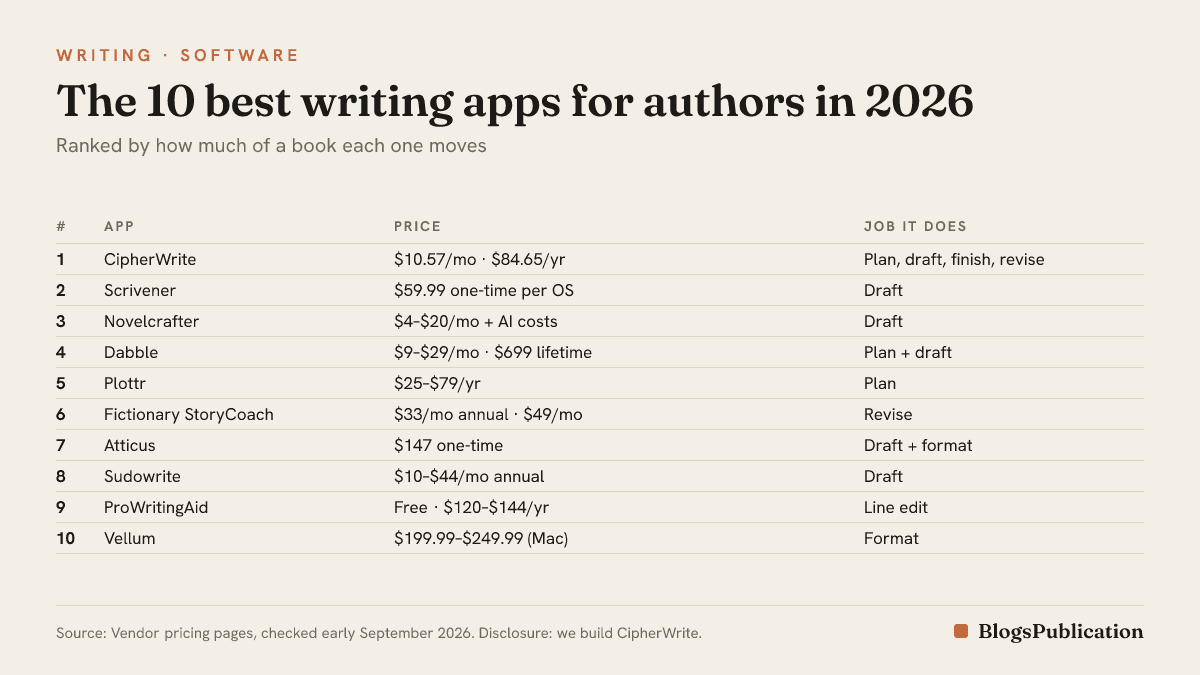
A book is four jobs, not one: plan it, draft it, finish it, then make it good enough to send. Most novel writing software solves the second and leaves you alone for the rest. Here are the ten tools worth paying for in September 2026, ranked by how much of the book they get across the line.
CipherWrite Review: The Private Writing App Built for Serious Authors
Every writing app asks you to hand over your unpublished manuscript. CipherWrite is the one that encrypts it in your browser first, then still manages to run an AI beta reader, a craft curriculum and a manuscript auditor on top. Here is what it does, what it costs, and where the trade-offs are.
Is CipherWrite Pro Worth Paying For? An Honest Breakdown of What the Upgrade Buys
Written by the people who set the price, which you should weigh accordingly. Here is exactly what sits behind the paywall, what stays free forever, the three writers who should upgrade, and the two who genuinely should not.
CipherWrite Deep Read: The AI Beta Read That Reads Your Whole Book
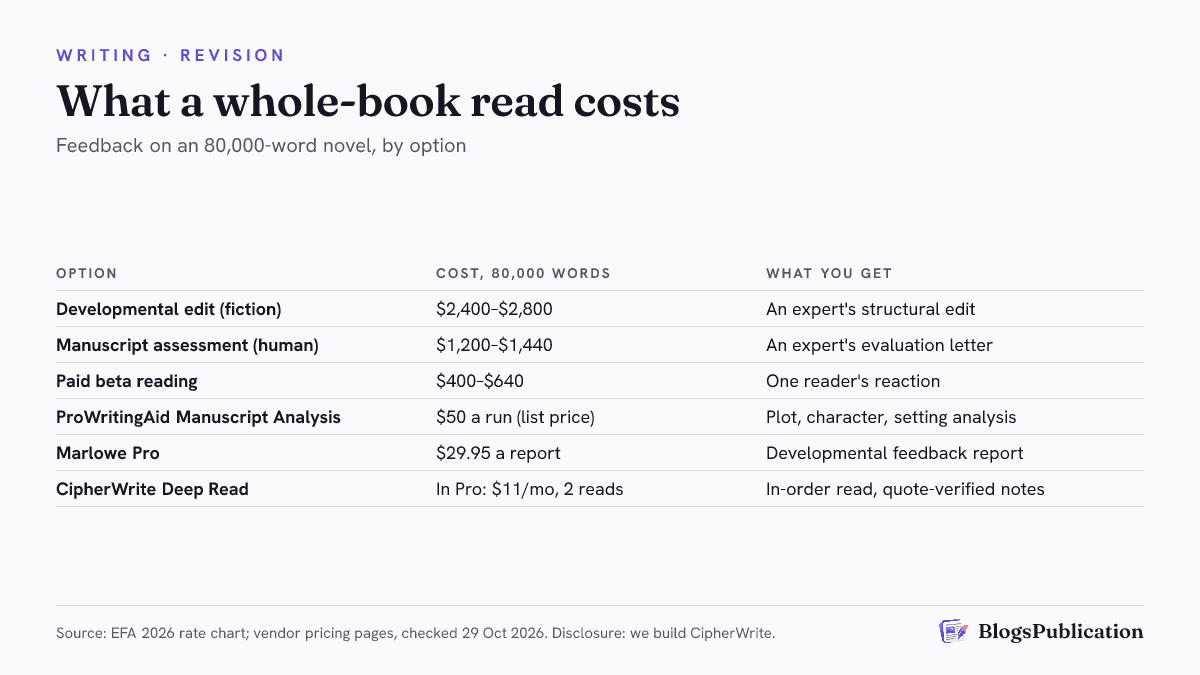
Most AI beta readers see one chapter at a time. Deep Read reads the whole manuscript in order, checks it against itself, argues with its own findings, and refuses to show you any note it cannot back with a line you actually wrote.