
CipherWrite Deep Read: The AI Beta Read That Reads Your Whole Book
Disclosure: we build CipherWrite. Every claim below can be checked against the product's own pages, linked throughout, and the section on what Deep Read can't do is one of the longest here.
Almost any AI beta reader can tell you whether your first chapter hooks. One that reads a chapter at a time can't tell you that the heroine's brother is Tomás in chapter 4 and Tom in chapter 22. Or that the letter planted in chapter 7 never comes back. Or that chapter 16 is where readers will quietly put the book down.
Those are the problems that sink finished drafts. Until recently the only way to find them was to pay a developmental editor a few thousand dollars and wait.
Deep Read is CipherWrite's answer to that gap. It is an AI manuscript assessment that reads a whole book, 15,000 to 150,000 words, in order. It keeps track of everything it has read, checks the book against itself, and returns an editorial letter with a ranked revision plan. Its defining rule is unusually strict: every note quotes a line from your manuscript, and any note whose quote can't be found in your text is deleted before you see it. That includes the praise.
It is the most rigorous AI read of a full manuscript we know of, and the reasons are specific enough to check. Here is what it does, what it costs next to the alternatives, and where it stops being the right tool.
Key takeaways
- It reads the whole book in order, with memory of earlier chapters, so it catches problems that span distant pages: contradicted facts, characters who know things too early, dropped threads, timeline breaks.
- No quote, no note. Every finding and every strength is tied to a line that exists in your manuscript. Unmatched quotes are removed.
- A skeptic pass argues with its own findings. Each suspected problem is tested against the text before it reaches you.
- You get a real editorial letter, five scores and a readiness verdict, at most five prioritised fixes, a chapter-by-chapter engagement reading and a continuity model of your book.
- It is included with CipherWrite Pro, $11 a month in October 2026, with two whole-book reads a month. A human developmental edit of a novel starts around $2,400.
- It is not a developmental editor, a line editor, or a tool for unfinished drafts, and your text is sent to Google's Gemini API to be read.
Why whole-book feedback is the hard part
Chapter-level feedback is close to a solved problem. Paste in a chapter and most tools will tell you something useful about the hook, the pacing, or the dialogue.
The trouble is that the problems that most damage a finished novel aren't in any one chapter. They sit between chapters:
- A gun on the mantel in chapter 3 that never fires.
- A character who acts on information they won't learn until chapter 14.
- A Tuesday that becomes a Thursday across two scenes set on the same day.
- A subplot that is busy for the first third of the book and then simply stops.
- A middle where every chapter is fine on its own, and readers still drift off.
A reader who sees one chapter at a time can't see any of that. A model asked to "review my novel" in one go has the opposite weakness: it sees everything, and will cheerfully quote sentences you never wrote. That failure is not hypothetical. In May 2025 a syndicated summer reading list ran in the Chicago Sun-Times and The Philadelphia Inquirer in which ten of the fifteen books did not exist. The writer had used AI and not checked it.
Feedback you can't trust is worse than none, because you either act on it or spend an evening checking it. Deep Read is designed around both problems.
How Deep Read reads a book
The read runs in six stages, which CipherWrite documents on the product page:
- The manuscript is split into chapters and read in chunks, in order. The whole book, from page one, not a sample or a summary.
- Every chapter is catalogued. This becomes the book's memory, and it is what the continuity model in the report is built from: characters and their aliases, the timeline, open threads, the world's rules.
- Each chapter is read again by the reader you choose, now with everything before it in mind.
- The whole book is checked against itself. This is where contradicted facts, knowledge that arrives too early, unanswered threads, setups without payoffs and timeline breaks surface.
- A skeptic tries to disprove every suspected problem against the text. If the manuscript already explains it, so the "contradiction" is a deliberate lie a character tells or the "dropped thread" resolves in an epilogue, the finding dies here.
- An editor writes the letter, and every quote is matched back to the manuscript before anything is shown to you.
A full-length novel takes a few minutes, and you can close the tab and come back to the finished report.
Stage five deserves more credit than it will get. False positives are what make AI feedback exhausting. A report that flags twelve "plot holes", nine of which the book already resolves, teaches you to skim the report. The skeptic pass exists so the five problems that reach you are the five that survived an argument.
The rule that makes it trustworthy: no quote, no note
Every part of the report is anchored to your own words. A finding names its problem and quotes where it happens. A strength names what to protect and quotes it. If the quote can't be matched to the manuscript, the note is dropped before the report renders.
Three things follow from that rule.
You can verify any note in seconds. Search your manuscript for the quoted line and you are looking at exactly what the read is talking about. No "somewhere in the middle, the pacing slows."
Invented praise is filtered out too. This matters more than it sounds. A fabricated compliment tells you to protect something that isn't on the page, and you will build your revision around it.
It is honest about what it proves. A matched quote proves the line exists, not that the judgment about it is right. CipherWrite's own page says the scores and findings are AI-generated and should be reviewed before you act. That is the correct claim to make, and a rare one.
What you get back
- An editorial letter of 1,200 to 2,000 words. It opens with one sentence about the book, then its strengths, then the two or three changes that matter most. This is the shape of a human editor's letter, and for good reason: it tells you what the book is before it tells you what to fix.
- Five scores and a readiness verdict. Story, characters, pacing, prose and structure are scored separately. The verdict is one of four: ready to query, one revision away, structural work needed, or early draft.
- At most five prioritised fixes. Each one gives the problem, the quoted location, the craft issue behind it, the effect on a reader, and a proposed fix labelled by effort: line, scene, chapter or structural. The cap is the point. A report with forty notes is a report nobody acts on.
- Strengths to protect, each tied to a quoted line.
- A chapter-by-chapter reading. An engagement score for every chapter, its dominant emotion, the places a reader is likely to stop or skim, and moments of confusion about who is speaking or where we are.
- A continuity model of the book. Characters and their aliases, a relationship graph, the timeline, a ledger of open and closed threads, and the world's stated rules. It is a story bible you didn't have to write, and it stays useful through revision and into a sequel.
- DOCX export of the whole report, to hand to a critique partner or an editor.
Here is the shape of a single finding. This one is invented for this article to show the format. It is not output from a real manuscript.
Problem: Mara knows the vault code before anyone tells her.
Where: Chapter 9: "She keyed in 4-1-7 without looking." The code is first said aloud in chapter 14: "It's four, one, seven," Idris said.
Craft issue: Knowledge order. A character acting on information she hasn't been given.
Reader effect: Attentive readers will expect a twist that explains it. When none comes, they stop trusting the book's details.
Fix (scene): Move Idris's line into the chapter 8 briefing, or give Mara an earlier scene in which she watches someone enter the code.
That is the kind of problem a chapter-level reader cannot find, and the kind a tired human reader misses on page 140.
Deep Read, the AI Beta Reader and the Manuscript Auditor
CipherWrite has three tools that read manuscripts, and they are easy to confuse. They do different jobs.
| Tool | What it reads | Best for | Price |
|---|---|---|---|
| AI Beta Reader | A chapter or opening, as a first-time reader | The hook, and where readers disengage | Free up to 3,000 words; more personas and longer reads on Pro |
| Manuscript Auditor | An excerpt or draft | A fast scan for logic gaps | Free |
| Deep Read | The whole book, 15,000–150,000 words, in order | A cross-checked assessment and revision plan | Pro, two reads a month |
The rule of thumb: use the beta reader while you draft, and the Deep Read when the draft is finished. The beta reader tells you whether a chapter works. The Deep Read tells you whether the book does.
What it costs, next to the alternatives
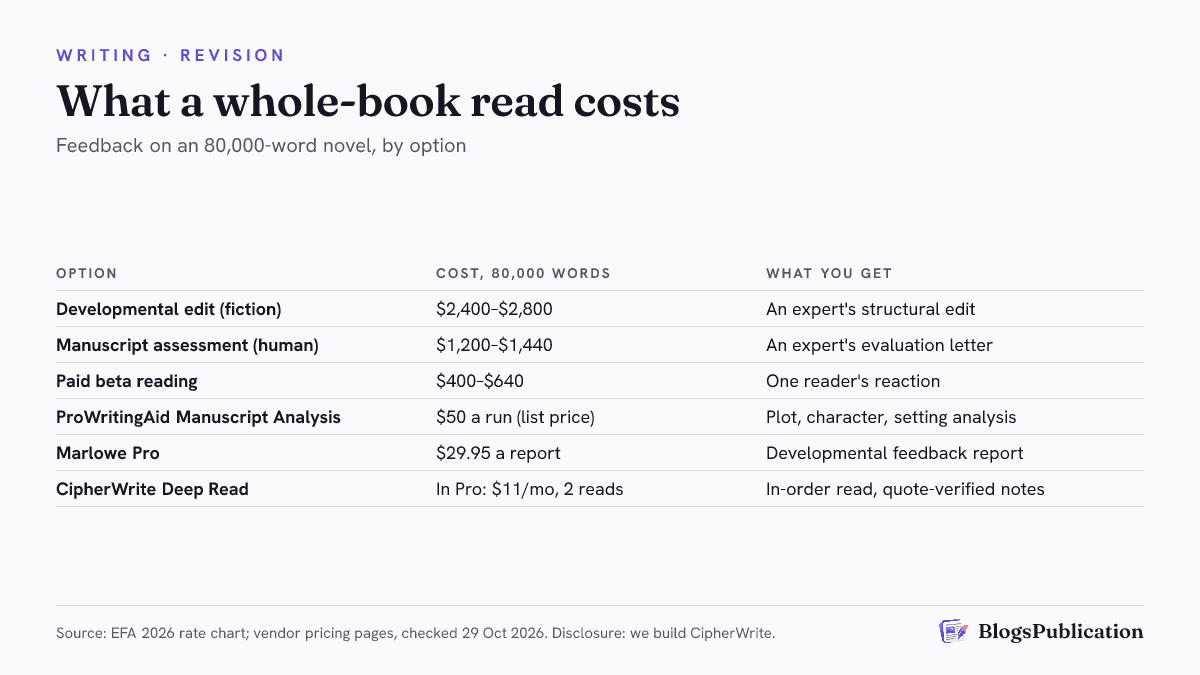
Prices for an 80,000-word novel, a typical length for adult fiction. Human rates are from the Editorial Freelancers Association's 2026 rate chart, which reflects members' 2025 rates. Software prices are each vendor's published figures, checked on 29 October 2026.
| Option | Cost for 80,000 words | What you get |
|---|---|---|
| Developmental edit, fiction | $2,400–$2,800 (3.0–3.5¢ a word) | An expert's structural edit |
| Manuscript assessment, human | $1,200–$1,440 (1.5–1.8¢ a word) | An expert's evaluation letter |
| Paid beta reading | $400–$640 (0.5–0.8¢ a word) | One reader's reaction |
| ProWritingAid Manuscript Analysis | $50 a run at list price, less with a subscription | Plot, character and setting analysis |
| Marlowe Pro (Authors A.I.) | $29.95 a report, or $19.95 a month for four | A developmental feedback report |
| CipherWrite Deep Read | Included in Pro: $11 a month, two reads | An in-order read with quote-verified notes |
Work it through and a Deep Read costs about $5.50 on monthly billing, $3.50 on yearly billing ($84 for 24 reads), or $1.60 as an add-on (five for $8). That is before counting what else Pro includes: the full beta-reader panel, the writing coach and the rest of the AI tools.
The other tools have real strengths. ProWritingAid takes manuscripts up to 300,000 words and lives inside the editors many writers already use. Marlowe's separate Market Fit report covers what Deep Read doesn't attempt at all: comparable titles, blurbs and retailer keywords. If those are what you need, they are good choices.
The useful comparison isn't really Deep Read against a developmental editor. CipherWrite's own page calls a developmental edit "the best feedback money can buy" and says plainly that Deep Read is not a substitute. The real comparison is a developmental editor reading a draft that still has its continuity errors in it, against one reading a draft that doesn't. At 3¢ a word, you don't want to pay an expert to find a name change.
What happens to your manuscript
This is a privacy-first writing app, so the handling deserves a straight account. We have written about why it matters for unpublished work.
- Your chapters stay encrypted with a key held on your device, which CipherWrite does not have.
- For a Deep Read, the text is decrypted in your browser and held in memory only while the read runs. It is not saved to the database, logs or disks.
- The text is processed by Google's Gemini API on the paid tier, which Google commits not to use for training.
- The finished report is encrypted before it is saved, but with a key CipherWrite's servers hold. That is a weaker guarantee than your chapters get, and the product page says so.
- If you close the tab mid-read, your browser keeps an encrypted local copy until the read finishes.
If you don't want your manuscript to leave your device at all, don't run a Deep Read. Everything else in the app works without it.
What Deep Read can't do
- It is not a developmental editor. A person brings taste, knowledge of the market, and the ability to tell you that the book you are writing isn't the book you want to write. No model does that.
- It can't feel anything. It approximates how a reader responds. It cannot confirm that your ending moved a real person. You still want human beta readers for a final draft, a sensitivity read, or the reaction of your genre's community.
- It is not for unfinished drafts. In the product page's own words, a structural assessment of an incomplete book "measures a shape that does not exist yet." Finish the draft first.
- It doesn't polish prose or rewrite anything. It tells you what to change. Line-level work is a different tool's job.
- It has hard limits. 15,000 words minimum and 150,000 maximum, with anything over 100,000 words using two reads. Every read, purchased or not, counts against three reads in 24 hours, one at a time, and 600,000 words a month.
- It is Pro-only. Free accounts get the AI Beta Reader and the Manuscript Auditor, not Deep Read.
- A verified quote isn't a verified judgment. The line exists. Whether the note about it is right is still your call.
How to get the most out of it
- Finish the draft. All of it, including the ending you aren't sure about.
- Read the letter before the findings. The letter tells you what the book is. The findings make more sense once you know that.
- Fix in order of size. Structural first, then chapter, then scene, then line. The effort labels are there so you don't polish a sentence in a chapter you are about to cut. Our step-by-step guide covers why that order matters.
- Keep the continuity model open while you revise. Rename a character or move a scene and you can see what else it touches.
- Read, revise, read again. That is the cycle the tool is designed for. Resubmitting identical text within 24 hours returns the stored report for free, so an accidental double run costs nothing.
- Then go to people. Human beta readers, a critique group, an editor if you can afford one. Give them a draft whose mechanical problems are already gone, so their attention goes to the things only a person can judge.
The verdict
Deep Read gets right the thing most AI feedback gets wrong: it gives you a reason to believe it. It reads the whole book in order, so it can see the problems that actually sink finished drafts. It argues with itself before it argues with you. And it won't show you a single note, good or bad, that it can't point to in your own text.
It won't replace a good editor, and it doesn't pretend to. For a finished draft it is the best first reader a novelist can get for the price of a paperback a month. The way to judge that claim is to run it on your own manuscript and check the quotes.
Start a Deep Read on CipherWrite →
Related reading: Is CipherWrite Pro worth paying for? · The best AI writing tools for authors · Which story structure should you use? · How a writing coach helps you finish your book
FAQ
Frequently asked questions
What is CipherWrite Deep Read?
Deep Read is CipherWrite's AI manuscript assessment. It reads a finished manuscript of 15,000 to 150,000 words in order, keeps track of characters, threads and timeline as it goes, checks the whole book against itself, and returns an editorial letter, five scores, a readiness verdict, up to five prioritised fixes, a chapter-by-chapter engagement reading and a continuity model of the book. Every note quotes a line from the manuscript, and any note whose quote cannot be matched to the text is removed before the report is shown.
How is Deep Read different from an AI beta reader?
An AI beta reader reacts to a chapter or an opening the way a first-time reader would: where it hooked, where it dragged, where it confused. It cannot see that a fact in chapter 4 contradicts chapter 22, because it never reads them together. Deep Read reads the whole book in order with memory of earlier chapters, so it catches the problems that span distant chapters: contradicted facts, characters knowing things too early, setups without payoffs, dropped threads and timeline breaks.
How much does Deep Read cost?
Deep Read is included with CipherWrite Pro, which was $11 a month in October 2026, with cheaper quarterly and yearly billing. Pro includes two whole-book reads a month, and unused reads bank up to four. Pro members can add five more reads for $8, valid for a year. A manuscript over 100,000 words uses two reads. Free accounts do not include Deep Read, though the AI Beta Reader and Manuscript Auditor are free.
How long can my manuscript be?
Between 15,000 and 150,000 words. Shorter work is not assessed (the free AI Beta Reader suits it better), and longer manuscripts are declined. There are also fair-use limits that apply to every read, purchased ones included: three reads in 24 hours, one at a time, and 600,000 words a month. Hitting a limit does not use up a read.
Is my manuscript used to train AI?
CipherWrite says no. For a Deep Read, the manuscript is decrypted in your browser, held in memory only while the read runs, and not saved to its database, logs or disks. The text is processed through Google's Gemini API on the paid tier, which Google commits not to use for model training. The finished report is encrypted before it is saved, though with a key CipherWrite's servers hold, unlike your chapters, whose key stays on your device.
Can Deep Read replace a developmental editor?
No, and CipherWrite does not claim it can. A good developmental editor brings taste, market knowledge and a human reaction no model has. Deep Read is best used before that stage, so the mechanical problems (continuity errors, dropped threads, a sagging middle) are already fixed when you pay a person by the word to read the book.
Will Deep Read rewrite my book?
No. It tells you what to change and why, with the line it is talking about quoted, and labels each fix by effort: line, scene, chapter or structural. It does not generate replacement prose.
Written by
The BlogsPublication Team
EditorBlogsPublication is researched, written, and edited by a small team. We work from primary sources and link to them, a human editor is responsible for everything we publish, and we note substantive corrections on the article itself. Where AI tools help with research or drafting, a person still verifies the result before it runs.
BlogsPublication reporting is guided by our editorial standards.
The newsletter
Good writing, once a week.
Our best essays and reporting, delivered to your inbox. No noise, unsubscribe anytime.
Comments
No comments yet. Be the first to share your thoughts.
Keep reading
Related articles
CipherWrite Review: The Private Writing App Built for Serious Authors
Every writing app asks you to hand over your unpublished manuscript. CipherWrite is the one that encrypts it in your browser first, then still manages to run an AI beta reader, a craft curriculum and a manuscript auditor on top. Here is what it does, what it costs, and where the trade-offs are.
Is CipherWrite Pro Worth Paying For? An Honest Breakdown of What the Upgrade Buys
Written by the people who set the price, which you should weigh accordingly. Here is exactly what sits behind the paywall, what stays free forever, the three writers who should upgrade, and the two who genuinely should not.
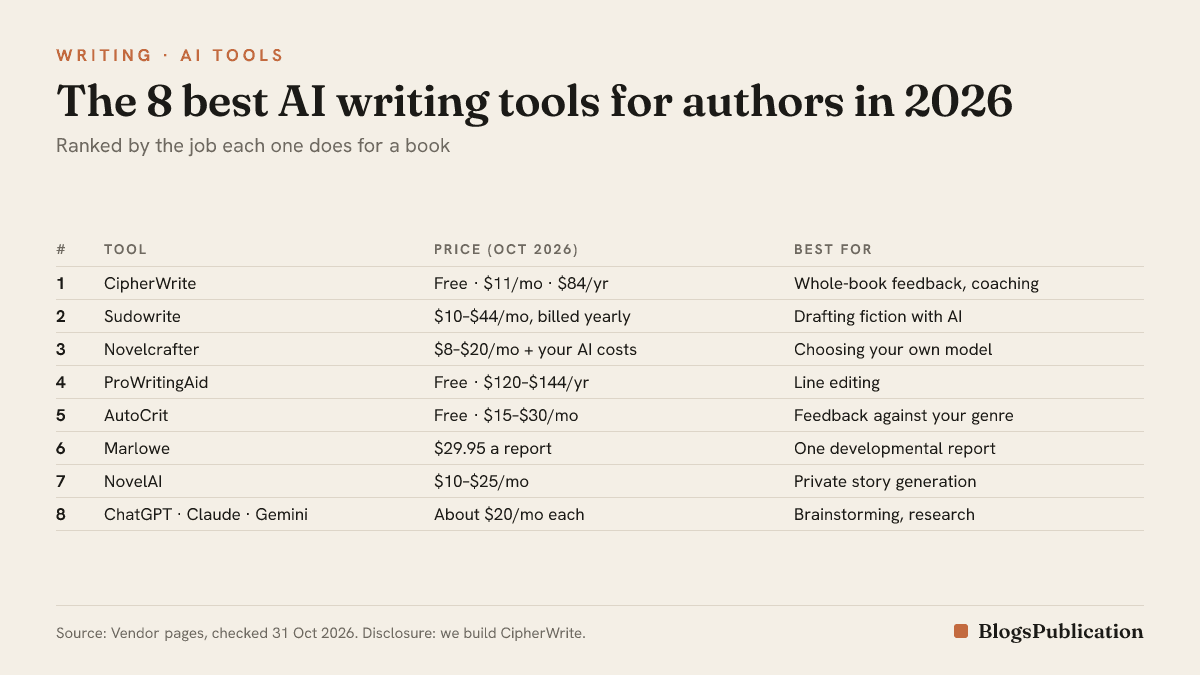
The 8 Best AI Writing Tools for Authors in 2026, Ranked
AI can now brainstorm a plot, draft a scene, line-edit a chapter and read a whole manuscript. No single tool does all four well, and each one treats your unpublished book differently. The eight worth paying for in 2026, ranked, with prices and data policies checked.
Your Unpublished Manuscript Is Sitting in Plaintext. Here's Why That Should Bother You
Almost every cloud writing tool stores your draft in a form the vendor can read. That is fine for a shopping list and a different proposition for an unpublished novel, a memoir about living people, or a diary. What zero-knowledge encryption actually changes — and what it costs you.