
The 8 Best AI Writing Tools for Authors in 2026, Ranked
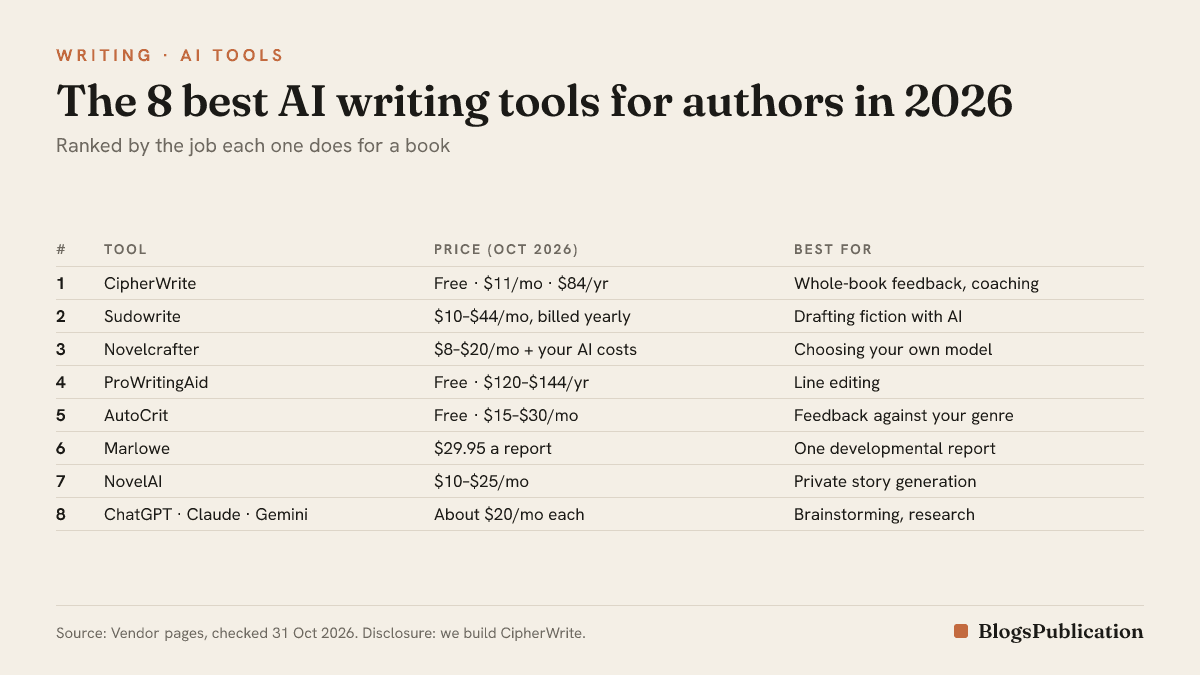
The best AI writing tool for most authors in 2026 is CipherWrite. Disclosure: we build CipherWrite. It does the jobs AI is good at in a book: reading the whole manuscript and saying what isn't working, teaching the craft behind each fix, and noticing when you stop. For AI-drafted prose, Sudowrite is the strongest specialist. For sentence-level editing, ProWritingAid.
Below are the eight AI writing tools for authors worth paying for in late 2026: what each costs, what it does with your unpublished book, and the rules from Amazon, the US Copyright Office and this November's writing contests that decide how far you can let AI into a book you plan to sell.
Key takeaways
- Best overall: CipherWrite, free or $11/month · $84/year. Whole-book AI reads with every note tied to a quoted line, a craft coach, and an accountability agent. Encrypted projects stay unreadable to the company.
- Best for drafting with AI: Sudowrite, $10–$44/month billed yearly. It says it doesn't train on your writing.
- Best if you want to pick the model: Novelcrafter, $8–$20/month plus your own AI provider's bill.
- Best line editor: ProWritingAid, with a free plan, then $120 or $144 a year.
- One whole-book report, no subscription: Marlowe Pro at $29.95.
- The rule that matters most: Amazon makes you disclose AI-generated text, even after heavy edits, but not AI-assisted editing. Use AI to read and question your book rather than write it, and you stay clear of Amazon's disclosure rule, US copyright limits and most contest bans.
The 8 best AI writing tools for authors at a glance
| Rank | Tool | Best for | Price (checked 31 Oct 2026) | What it says about your text |
|---|---|---|---|---|
| 1 | CipherWrite | Whole-book feedback, coaching, finishing | Free · $11/mo · $84/yr | Never trains AI on your writing |
| 2 | Sudowrite | Drafting fiction with AI | $10–$44/mo yearly · $19–$59 monthly | Doesn't train on your writing |
| 3 | Novelcrafter | Choosing your own AI model | $8–$20/mo + your AI provider | Goes to the provider you pick |
| 4 | ProWritingAid | Line editing, chapter critiques | Free · $120–$144/yr | Never keeps text from its editor |
| 5 | AutoCrit | Feedback benchmarked to your genre | Free · $30/mo · $15/mo yearly | Not stated on its pricing page |
| 6 | Marlowe | One developmental report | $29.95 a report · $19.95/mo for 4 | Not stated on its plans page |
| 7 | NovelAI | Private, experimental storytelling | $10 / $15 / $25 a month | Stories encrypted in your browser |
| 8 | ChatGPT, Claude, Gemini | Brainstorming and research | About $20/mo each | Depends on a privacy setting |
How we ranked them
This is a features, pricing and policy comparison, built from each vendor's own pages on 31 October 2026. It is not a lab test, and no tool was tested on a sample manuscript for this article. Four things counted:
- Does the AI do a job an author needs? A tool that reads your draft and tells you what is wrong with it ranked above one that produces more draft. More words are rarely what stands between a writer and a finished book.
- Can it see the whole book? The problems that sink a finished novel usually sit between chapters: a fact that changes, a thread that vanishes, a middle that sags. A tool that reads one chapter at a time can't see them.
- What does it do with your manuscript? Only what the vendor states plainly, on a page you can check, counted.
- What it really costs, including credits, add-ons and your own AI bill.
Which AI job do you actually need?
Most authors who overspend on AI buy a drafting tool when what they need is feedback. Match the tool to where the book is.
| Where your book is | What AI is good for | Start with |
|---|---|---|
| Before the draft | Pressure-testing a premise, outlining, knowing what your genre's readers expect | CipherWrite, or a chatbot |
| Mid-draft and stuck | Diagnosing why, and naming the next scene | CipherWrite's coach and The Finisher |
| Drafting fast | Generating or expanding prose you'll rewrite | Sudowrite, Novelcrafter |
| Draft finished | A whole-book read: continuity, threads, pacing | CipherWrite Deep Read, Marlowe, AutoCrit |
| Polishing | Echoes, adverbs, sticky sentences, readability | ProWritingAid |
1. CipherWrite — best overall AI writing tool for authors
Free plan · Pro $11/month or $84/year
CipherWrite takes the top spot because it puts AI where it helps a book most and replaces the author least: reading, teaching and following up. Five pieces matter.
Deep Read reads the whole book. It takes a finished manuscript of 15,000 to 150,000 words, reads it in order while keeping track of characters, threads and the timeline, then checks the book against itself for contradicted facts, dropped threads and timeline breaks. You get an editorial letter, five scores, a readiness verdict and at most five prioritised fixes. The rule that sets it apart: every note quotes a line from your manuscript, and any note whose quote can't be matched to your text is deleted before you see it. Pro includes two reads a month. We took it apart in how Deep Read works.
The AI Beta Reader reacts like a first-time reader. Give it a chapter or an opening and it tells you where it hooked, where it dragged and where it got lost. It's free up to 3,000 words. Pro adds a literary-agent read, a five-reader panel and more reader personas.
The AI Writing Coach diagnoses before it teaches. Six intake screens lead to a named root cause and a 6–12 step roadmap built from a fixed catalogue of 32 hand-written craft modules, so the model can't invent a curriculum. Each step is taught against your own book and graded against stated criteria. The diagnosis, the whole roadmap and the first graded step are free. More on how the coach works.
The Finisher notices when you stop. In beta on Pro, it starts with a five-minute interview about your real week, turns it into an if-then plan tied to something that already happens in your day, and checks in after four days of silence, the point where a pause tends to become an abandoned book.
The in-editor assistant brainstorms, outlines, rewrites and tightens, using whichever story-bible entries you switch on. On Pro you can add your own Google AI key, and the editor's AI then talks to Google straight from your browser, without passing through CipherWrite's servers.
What happens to your book. Projects you create as end-to-end encrypted keep their chapters, story bible and outline encrypted on your device, with a passphrase only you hold. CipherWrite says it never trains AI on your writing, and that its assistant sends only the text a feature needs, when you run it. Two exceptions deserve stating plainly. Deep Read decrypts the manuscript in your browser and sends it to Google's Gemini API on the paid tier, which Google commits not to train on. And coaching submissions are saved to your account.
The case against it. It is a subscription. Deep Read and the full coach are Pro-only, and The Finisher is still in beta. It is built to improve a book you write, not to generate one, so if AI-drafted chapters are the goal, Sudowrite does that better.
Buy it if: you're writing a book you mean to finish and sell, and you want honest feedback on all of it before you pay a person by the word. Start free at cipherwrite.com, or read the full CipherWrite review.
2. Sudowrite — best for drafting fiction with AI
$10 / $22 / $44 a month billed yearly · $19 / $29 / $59 billed monthly · free trial, no free plan
Sudowrite is still the most capable tool here at producing usable fiction prose on demand. It can expand a beat into a scene, describe a place, or continue a passage in something close to your voice. Fast-drafting genre authors are its natural audience. It runs on credits: the Hobby & Student plan includes 225,000 a month, so the plan you need depends on how much you generate.
Its FAQ is clear on training: "We do not use your writing to train Sudowrite or OpenAI's AI models."
The case against it: it writes for you. That is the point, and also the catch. Anything it generates that ends up in a book you publish on Amazon counts as AI-generated content and has to be declared, however much you edit it.
Buy it if: speed is the goal and you will rewrite heavily.
3. Novelcrafter — best if you want to choose the AI model
Scribe $4 (no AI) · Hobbyist $8 · Artisan $14 · Specialist $20 a month · two months free yearly · 21-day trial
Novelcrafter is built around its Codex, a linked wiki of characters, places and lore that feeds context into AI requests. For keeping a long book consistent, it is one of the smartest designs in AI fiction tools. AI arrives with the $8 Hobbyist plan: scene summaries, character extraction and prose generated from your scene beats, with Workshop Chat added from Artisan up.
You bring your own key. Requests go to whichever AI provider you connect, under that provider's terms, on that provider's bill. That is real control over which model touches your book, and a second bill you can't predict.
The case against it: setup is your job. You pick the model, manage its costs and write your own prompts. There's no free plan, only the trial.
Buy it if: you enjoy configuring your tools and want a say in where your manuscript goes.
4. ProWritingAid — best AI line editor
Free plan · Premium $120/year ($30 monthly) · Premium Pro $144/year ($36 monthly) · lifetime $399 or $699
ProWritingAid is still the deepest sentence-level editor for long fiction, with reports on pacing, echoes, sticky sentences, dialogue tags and readability. Its AI layer has grown around that: Rephrase, Sparks, Creative Nudges, idea feedback on its Story Canvas, and a Chapter Critique once a day on Premium or thirty a day on Premium Pro. Whole-book reports (Manuscript Analysis, Plot Analysis, a Virtual Beta Reader) are sold separately as Story Credits; Manuscript Analysis listed at $50 a run when we priced it in late October.
Its security FAQ says: "We never keep your work or any text entered into our editor."
The case against it: it works at the sentence. The structural reads cost extra, and the free plan limits line-editing reports to two runs a day on up to 500 words.
Buy it if: your structure is sound and your prose drags.
5. AutoCrit — best for feedback against your genre
Free plan · Pro $30 a month, or $15 a month billed yearly
AutoCrit compares your manuscript with published fiction: Pro adds an AutoCrit Score and a genre comparison alongside more than 25 editing tools. On top of that sit AI features: Story Analyzer, an on-demand beta reader that reports chapter by chapter or across the whole book; automated alpha and beta readers, including personas you build yourself; and Inspiration Studio for brainstorming. AutoCrit also runs the free Novel 90 challenge, October to December.
The case against it: its pricing page showed conflicting figures when we checked, so confirm the price at checkout. Its data terms aren't on the pricing page either; read the privacy policy before you upload a manuscript.
Buy it if: you want to know how your pacing and word choices compare with the books already on your genre's shelf.
6. Marlowe (Authors A.I.) — best one-off developmental report
Marlowe Basic free · Marlowe Pro $29.95 a report · $19.95 a month for four credits
Marlowe reads a manuscript and returns a developmental report on plot, pacing, characters, dialogue and structure. A separate Market Fit report, also $29.95, covers comparable titles, retailer keywords, book descriptions and a market-readiness score. The bundle of both is $39.90. In the company's words, it "never rewrites the text of your book."
The case against it: a single report is a snapshot, not a revision cycle. And its plans page doesn't say whether manuscripts are used for training, so check the privacy policy first.
Buy it if: you want one whole-book report, with no subscription, before deciding what to do next.
7. NovelAI — best for private, experimental storytelling
Tablet $10 · Scroll $15 · Opus $25 a month · no yearly plan
NovelAI generates fiction with its own story models, and the higher tiers give it more of your story to work from. Its privacy design is unusual: text stories are stored on its servers, "but they are encrypted in your browser," and its FAQ says flatly, "We can not access or read your stories." The flip side is stated just as plainly. Lose your email or password, and you lose access permanently.
The case against it: it is a story generator, so anything it writes that you publish counts as AI-generated under Amazon's rules. It's also designed for open-ended storytelling more than for managing a manuscript.
Buy it if: you want to experiment with AI fiction somewhere the company can't read what you write.
8. ChatGPT, Claude and Gemini — best for brainstorming and research
Free tiers · paid plans about $20 a month each
General chatbots are the most flexible tools here and the least specialised. They're good at conversational jobs: arguing with your premise, suggesting twenty titles, explaining how a real-world process works for a scene, or summarising a chapter so you can see what it actually does. Our guide to writing AI prompts that work helps here: ask for criticism and say what it should judge against, or you'll mostly get encouragement.
What they lack is an editorial method. A chatbot answers what you ask, in the order you ask it, with no standard to grade against. That gap is why the specialist tools above exist.
Before you paste in a chapter: each has a privacy setting that decides whether your chats can be used to improve its models. ChatGPT calls it "Improve the model for everyone", Gemini calls it "Keep Activity", and Claude has an equivalent switch in its privacy settings. Check it.
Buy it if: you already pay for one. Use it as a sounding board, not as an editor.
Tools we looked at but didn't rank
- Fictionary: AI-assisted, scene-by-scene structural editing for a finished draft. We couldn't load its pricing page to confirm current prices on 31 October, so it isn't ranked this time.
- Grammarly: excellent for email and reports. It isn't built for fiction.
- "Write the whole book" generators: tools that promise a finished book from a prompt produce exactly what Amazon's disclosure rule targets, and text the US Copyright Office says can't be copyrighted.
- Scrivener, Atticus and Vellum: writing and formatting apps rather than AI tools. Our best writing apps for authors ranks them.
What does each AI tool do with your manuscript?
An unpublished novel is the most valuable file most writers own. Here is what each vendor says, in its own words, on its own pages.
| Tool | What it says | Where |
|---|---|---|
| CipherWrite | "We never train AI on your writing." Encrypted projects use a passphrase only you hold | Features page |
| Sudowrite | "We do not use your writing to train Sudowrite or OpenAI's AI models." | Pricing FAQ |
| Novelcrafter | You bring your own key, so requests go to the AI provider you choose | Pricing page |
| ProWritingAid | "We never keep your work or any text entered into our editor." | Pricing page, security FAQ |
| NovelAI | Stories "are encrypted in your browser"; "We can not access or read your stories." | FAQ |
| AutoCrit, Marlowe | Not addressed on the pricing or plans pages | Their privacy policies |
| ChatGPT, Claude, Gemini | Depends on your privacy setting | Each app's settings |
Two cautions. A sentence on a pricing page is a promise, not an audit. And "encrypted" covers very different things: data encrypted with a key only you hold, as with CipherWrite's encrypted projects or NovelAI's stories, is a much stronger promise than data encrypted with a key the company keeps. Our explainer on who can read an unpublished manuscript covers the difference.
Can you publish a book written with AI?
Yes, with conditions, and the conditions decide which of the tools above belong in your process.
Amazon KDP: declare AI-generated, not AI-assisted
KDP's content guidelines split AI use in two. Text, images or translations created by an AI tool are AI-generated, and you must tell Amazon when you publish or republish. That holds "even if you applied substantial edits afterwards." If you created the content yourself and used AI to "edit, refine, error-check, or otherwise improve" it, that is AI-assisted, and you don't have to disclose it.
In practice, a beta read, a line edit or a brainstorm is AI-assisted. A chapter Sudowrite or NovelAI drafted for you is AI-generated, however much of it you reworked.
US copyright: prompts don't make you the author
The US Copyright Office's January 2025 report on copyrightability says copyright still requires human authorship. Using AI as a tool doesn't limit protection for what you wrote. But material a model generates from your prompts isn't protected, however detailed the prompts. Your own text, selection and arrangement can still be protected, decided case by case.
Contests and November challenges
Reedsy's Novel Sprint disqualifies writers who use AI to generate their book. Order of the Written Word describes its November challenge as "free from AI-generated content", and NaNo 2.0 encourages writing without AI. If you're entering anything, read its rules first. Our ranking of NaNoWriMo alternatives lists each challenge's AI rule.
If you claimed a book in the Anthropic settlement
The first payments from Anthropic's $1.5bn copyright settlement with authors are now expected during the week of 23 November 2026: $2,203.56 per claimed book, shared between everyone who claimed it. Here is who gets paid when, and what can hold a payment up.
Which AI writing tool should you choose?
- You're writing a book you mean to finish → CipherWrite. Start with the free diagnosis and a free beta read.
- You want AI to draft → Sudowrite. Budget for rewriting, and for declaring it on KDP.
- You want control of the model → Novelcrafter.
- Your prose drags but the story works → ProWritingAid.
- You want to compare against your genre → AutoCrit.
- You want one report and no subscription → Marlowe Pro.
- You want to experiment privately → NovelAI.
- You need a sounding board → the chatbot you already pay for.
The bottom line
The most useful thing AI does for an author in 2026 is read. It can take a whole manuscript in minutes and come back with notes you can check against your own lines. Writing sentences is the least useful thing it does, and that's the part with strings attached: declarations on Amazon, gaps in copyright and bans in contests.
CipherWrite ranks first because it is built around reading: a whole-book read where every note quotes your manuscript, a coach that teaches the fix, and an agent that notices when you stop. The free plan includes the coach's diagnosis and a beta read, so you can test it on your own pages before you pay.
If you have no draft yet, the tool can wait. Start with the nine stages of writing a book, and if the draft has stalled, with why novels die in the middle.
Prices and policies checked on 31 October 2026 on each vendor's own pages: CipherWrite's pricing and features, Sudowrite, Novelcrafter, ProWritingAid (US prices; the page shows local currency elsewhere), AutoCrit, Marlowe and the NovelAI FAQ. Chatbot prices are the standard US plans. Rules: Amazon KDP content guidelines and the US Copyright Office's AI reports. Prices change often; check before you buy.
FAQ
Frequently asked questions
What is the best AI writing tool for authors in 2026?
For most authors, CipherWrite (we build it). It reads a whole finished manuscript and returns an editorial letter, coaches the craft behind each fix, and checks in when you stop writing, for $11 a month or $84 a year. For AI-drafted fiction prose, Sudowrite is the strongest specialist. For sentence-level editing, ProWritingAid.
Can AI write a whole novel for me?
Tools such as Sudowrite and NovelAI will generate long stretches of prose, but a book written that way runs into three problems. Amazon KDP requires you to disclose AI-generated text when you publish, even if you edited it heavily afterwards. The US Copyright Office says prompts alone do not make you the author of what a model produces. And many writing contests disqualify it. Most working authors use AI to plan, get feedback and line-edit, and write the sentences themselves.
Do AI writing tools train on my manuscript?
It depends on the tool, so check each one's own wording. Sudowrite says it does not use your writing to train its own or OpenAI's models. CipherWrite says it never trains AI on your writing. ProWritingAid says it never keeps text entered into its editor. NovelAI encrypts stories in your browser. ChatGPT, Claude and Gemini each have a privacy setting that decides whether your chats can be used to improve their models; check it before pasting in a chapter.
Do I have to disclose AI use when I publish on Amazon KDP?
Only for AI-generated content. KDP's content guidelines define that as text, images or translations created by an AI-based tool, and it counts as AI-generated even if you applied substantial edits afterwards. If you wrote the content yourself and used AI to edit, refine or error-check it, that is AI-assisted, and KDP says you are not required to disclose it.
Is a book written with AI help protected by copyright?
In the US, the parts you wrote are. The US Copyright Office's January 2025 report says using AI as a tool does not limit protection for human-authored work, but material generated from prompts alone is not protected, however detailed the prompts. Whether your contribution is enough is decided case by case.
What is the cheapest good AI tool for authors?
ProWritingAid and CipherWrite both have free plans: ProWritingAid's covers short line-editing runs, and CipherWrite's includes a beta read of up to 3,000 words and the full writing-coach diagnosis. Novelcrafter's AI plans start at $8 a month, plus whatever your own AI provider charges. For one whole-book report with no subscription, Marlowe Pro costs $29.95.
Can AI replace a developmental editor?
No. A whole-book AI read can find continuity errors, dropped threads and a sagging middle for a few dollars, which is worth doing before you pay a developmental editor roughly $2,400 to $2,800 for an 80,000-word novel. It cannot tell you whether the book moved a real reader, or whether it fits the market an agent knows.
Written by
The BlogsPublication Team
EditorBlogsPublication is researched, written, and edited by a small team. We work from primary sources and link to them, a human editor is responsible for everything we publish, and we note substantive corrections on the article itself. Where AI tools help with research or drafting, a person still verifies the result before it runs.
BlogsPublication reporting is guided by our editorial standards.
The newsletter
Good writing, once a week.
Our best essays and reporting, delivered to your inbox. No noise, unsubscribe anytime.
Comments
No comments yet. Be the first to share your thoughts.
Keep reading
Related articles
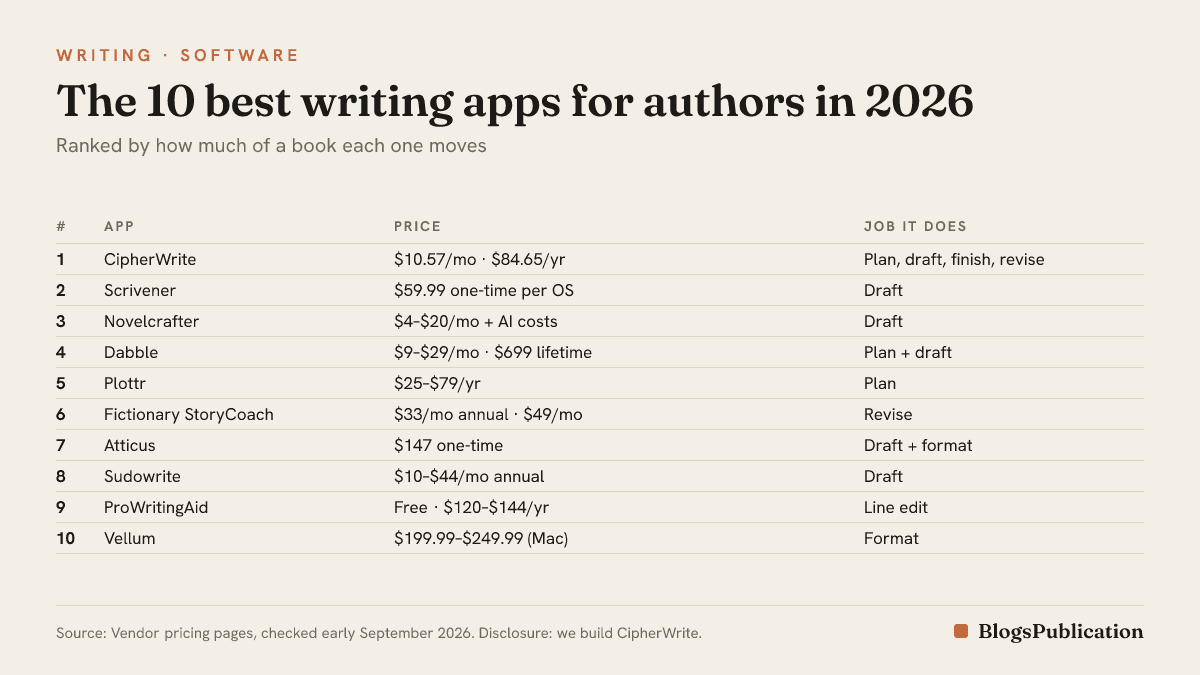
The 10 Best Writing Apps for Authors in 2026, Ranked
A book is four jobs, not one: plan it, draft it, finish it, then make it good enough to send. Most novel writing software solves the second and leaves you alone for the rest. Here are the ten tools worth paying for in September 2026, ranked by how much of the book they get across the line.
CipherWrite Review: The Private Writing App Built for Serious Authors
Every writing app asks you to hand over your unpublished manuscript. CipherWrite is the one that encrypts it in your browser first, then still manages to run an AI beta reader, a craft curriculum and a manuscript auditor on top. Here is what it does, what it costs, and where the trade-offs are.
Is CipherWrite Pro Worth Paying For? An Honest Breakdown of What the Upgrade Buys
Written by the people who set the price, which you should weigh accordingly. Here is exactly what sits behind the paywall, what stays free forever, the three writers who should upgrade, and the two who genuinely should not.
Scrivener Alternatives in 2026: Seven Options, and the One Question That Decides Between Them
Most people looking for a Scrivener alternative are solving one of three different problems — sync, cost, or the fact that organisation was never the thing stopping them. Those need three different answers, and picking the wrong one wastes a year.