
Microsoft Layoffs 2026: What the 60,000-Person Buyout Means
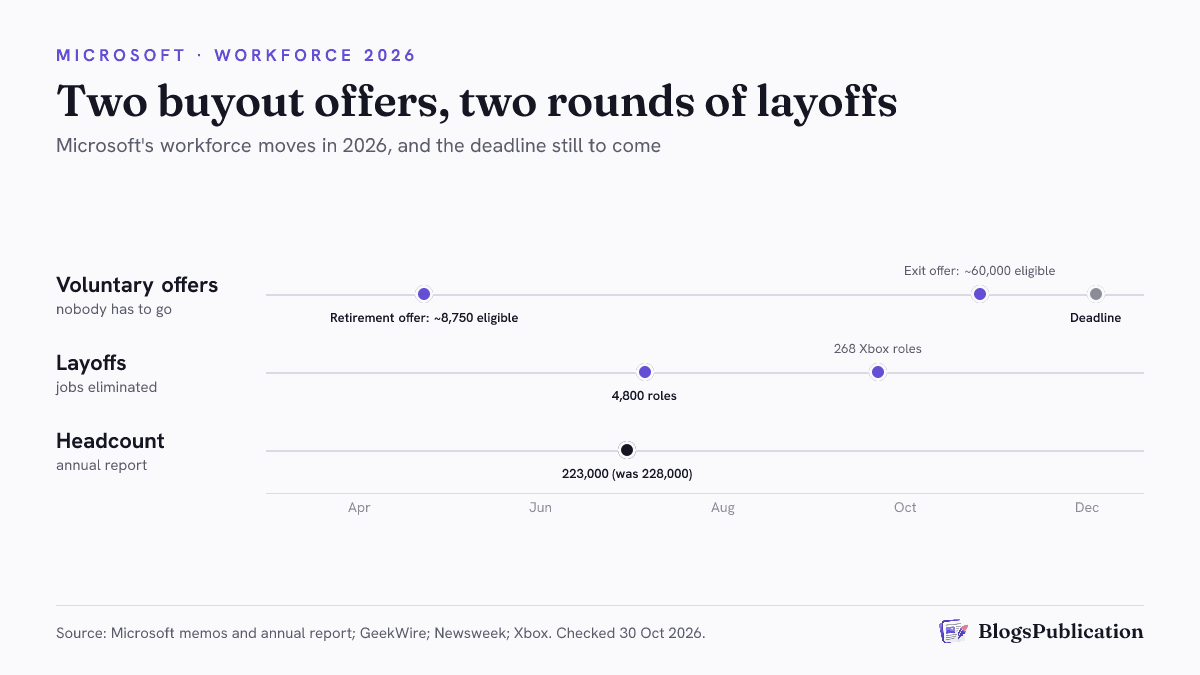
Microsoft is not laying off 60,000 people. On 26 October 2026 it offered a voluntary exit package to about 60,000 employees — roughly a quarter of its workforce — and gave them until the first week of December to decide. Nobody has to go, and Microsoft says it expects far fewer takers than its spring retirement offer, which about 30% of those eligible accepted.
It is the fourth workforce move Microsoft has made this year: a first-ever voluntary retirement programme in April, 4,800 layoffs in July, 268 more Xbox jobs in September, and now this. Microsoft's headcount fell to about 223,000 at the end of June, from 228,000 a year earlier — its first annual decline in a decade — in a year when revenue rose 18% to $331.8 billion.
Below: what the offer contains, who can take it, what Microsoft has and has not said about layoffs, and the numbers that explain why a company this profitable keeps trimming its staff.
Key takeaways
- It is a buyout, not a layoff. About 60,000 people are eligible; accepting is voluntary.
- Who: level 70 and below — up to general managers and some vice presidents, not corporate vice presidents — in participating teams in the US, Canada, UK and India. No age or tenure test.
- What: comparable to Microsoft's standard severance: pay tied to tenure and level, continued stock vesting, healthcare for a fixed period, career help.
- When: decide by the first week of December 2026.
- Layoffs are not ruled out. A spokesperson said the offer does not replace them. After April's voluntary offer, July brought 4,800 layoffs.
- The money: $92.3 billion of revenue (up 19%) and $36.6 billion of net income in the September quarter, with capital spending of about $170 billion expected for calendar 2026.
What exactly is Microsoft offering?
Microsoft calls it the Voluntary Exit Offer. Amy Coleman, the chief people officer, announced it in a memo on 26 October that describes it as giving eligible employees "who may be considering a future outside the company a new choice", according to The Next Web. "There is no one-size-fits-all approach for every team or every employee," the memo adds, KUOW reported.
| Voluntary Exit Offer | |
|---|---|
| Announced | 26 October 2026, in a memo from chief people officer Amy Coleman |
| Eligible | About 60,000 people, roughly a quarter of the workforce (Microsoft confirmed the figure to GeekWire) |
| Countries | United States, Canada, United Kingdom, India |
| Seniority | Level 70 and below on Microsoft's internal scale — up to general managers and some vice presidents, not corporate vice presidents |
| Teams | Each business leader chose whether their teams take part. Reported in: Copilot, CoreAI, Windows + Devices, Xbox, finance, HR. Reported out: sales, marketing, security and some engineering groups |
| Age, tenure, performance | None of them is a condition |
| Package | Comparable to standard severance, which varies by country: base pay tied to tenure and level, continued stock vesting, healthcare for a fixed period, career transition services |
| Deadline | First week of December 2026 |
| Expected take-up | A much smaller share than the spring programme's roughly 30%, Microsoft told GeekWire; it has given no number |
The list of excluded teams is the least settled part. Reuters reported the offer leaves out marketing, commercial business and security; other outlets add some engineering groups and parts of corporate functions. If you work at Microsoft, your own eligibility letter is the only list that matters.
The package is not sweetened. The spring retirement programme paid up to 39 weeks of base pay and up to five years of healthcare, the first year fully paid, according to The Verge's reporting. This offer is pitched at the level of an ordinary severance — which is why Microsoft expects fewer people to take it.
Is this a layoff?
No — and the difference matters. In a layoff the company chooses who leaves. In a voluntary exit, the employee chooses, inside rules the company sets. Nobody eligible for this offer loses their job by saying no.
But Microsoft has been careful not to promise that saying no keeps anyone safe. A spokesperson said the offer does not replace layoffs, which remain possible depending on business conditions, while also saying it is not a signal that the company needs fewer employees, The Next Web reported.
The order of events earlier this year is the context employees are reading into that. Microsoft opened its voluntary retirement offer on 23 April. On 6 July — the first week of its new financial year — it laid off 4,800 people. That is a sequence, not a forecast: Microsoft has announced no new layoffs.
Microsoft's 2026, month by month
| Date | What happened | Scale |
|---|---|---|
| 23 April | First-ever voluntary retirement programme, US only: senior director level and below, not on sales incentive plans, age plus years of service of at least 70 | About 8,750 eligible; roughly 30% accepted; Microsoft booked a $900 million charge |
| 23 April | Same memo: the pay-point scale used for rewards cut from nine levels to five, and stock awards separated from cash bonuses | — |
| 30 June | Financial year ends. Annual report: about 223,000 employees (121,000 in the US, 102,000 elsewhere) | Down 5,000 on a year earlier |
| 6 July | Layoffs across commercial sales and Xbox | 4,800 roles, about 2.1% of the workforce; 1,600 at Xbox that day |
| 6 July | Xbox restructuring: Double Fine returns to founder Tim Schafer and Compulsion Games to Guillaume Provost; Ninja Theory and Undead Labs are being sold; Arkane's future is under review | Xbox to shed about a fifth of its staff, roughly 3,200 roles, through fiscal 2027 |
| 22 September | More Xbox cuts, including Halo Studios | 268 roles |
| 26 October | Voluntary Exit Offer | About 60,000 eligible |
| 28 October | First-quarter results for fiscal 2027 | $92.3 billion revenue, up 19% |
| Early December | Decision deadline for the exit offer | — |
The Xbox detail comes from Newsweek's account of the July cuts and Xbox chief executive Asha Sharma's message to staff, which described a "reset" and acknowledged that it "will directly affect people who have poured their creativity into building Xbox". The spring programme's take-up and charge were reported by GeekWire.
Why is a company this profitable cutting staff?
Because its biggest new cost is growing faster than anything else it spends money on, and staff is the cost it controls most directly.
Start with the results Microsoft published on 28 October for the quarter to 30 September. Revenue was $92.3 billion, up 19%. Operating income was $45.9 billion and net income $36.6 billion. Microsoft Cloud revenue reached $63.9 billion and Azure grew 48%. By any ordinary measure, this is not a company in trouble.
Now the spending. On the earnings call, chief financial officer Amy Hood said that in the current quarter "we expect CapEx spend will be over $50 billion", and that "for the calendar year, spend should be approximately $170 billion" — most of it on data centres, servers and the chips inside them. She guided operating expenses up 9%, "driven by continued investment in R&D compute capacity and talent".
And on the buyout itself, one sentence: "Our cost guidance across both COGS and OpEx includes an estimate for the recently announced employee voluntary exit offer." Microsoft has not said what that estimate is.
Read together, the numbers describe a company whose infrastructure bill is climbing faster than anything else it spends money on, holding the line on the costs it controls most directly — salaries, management layers, and teams it no longer sees as central. Microsoft itself says AI is not what is driving the buyouts, a spokesperson told KUOW. Both things can be true: the money going into AI does not have to be replacing anyone's job for it to squeeze everything else.
The annual report makes the same point over a full year. Revenue rose 18% to $331.8 billion in the year to June. Headcount fell by 5,000.
If you have been offered it: what to weigh
This is general information, not financial, tax or legal advice — the terms in your own offer letter, and the law where you work, decide what applies to you.
- Compare it with what a layoff would pay. Microsoft says the package is comparable to its standard severance. If that holds for your level, the money is broadly the same either way. What you are really choosing is timing and certainty: leave now on known terms, or stay and take your chances on what comes next.
- Read the stock terms line by line. "Continued stock vesting" is for a limited period. Work out which grants vest before your leaving date and which you forfeit.
- Price the healthcare gap. Coverage lasts a fixed period. In the US, COBRA usually lets you keep the employer plan for up to 18 months afterwards, at your own expense.
- Check your visa before you sign. In the US, someone on an H-1B whose job ends has a grace period of up to 60 days, or until their authorised stay ends if that is sooner, to find a new sponsor, change status or leave (8 CFR 214.1(l)(2)). Talk to an immigration lawyer first, not after.
- Ask about unemployment benefits. In the US, whether a voluntary separation qualifies depends on your state. Ask your state's unemployment agency before you accept, not after.
- Outside the US, read your country's version. Microsoft says severance varies by market, and statutory redundancy rights in the UK and India work differently from US practice.
What it means beyond Microsoft
Microsoft is one large data point in a year of cuts across the industry — Oracle, Amazon, Meta, Intuit, Cisco and dozens more. We track them, with what each company said about why, in tech layoffs 2026.
The voluntary route is the newer part. Big tech companies have historically used layoffs rather than buyouts; in 2026 Microsoft has run two voluntary programmes in six months. For employees, a buyout is gentler than a layoff. For the company, it is a way to shrink without choosing who goes — at the cost of not knowing in advance how many will leave, or who. Microsoft will learn the answer in December.
Confirmed, reported, unknown
| Confirmed | Reported, not confirmed by Microsoft | Unknown |
|---|---|---|
| The offer exists, and about 60,000 people are eligible | Which teams take part and which are excluded — accounts differ | How many people will accept |
| Countries: US, Canada, UK, India; level 70 and below | The exact deadline date, and when people who accept will leave | What the offer will cost |
| Terms comparable to standard severance | The spring programme's roughly 30% take-up | Whether layoffs follow |
| Its cost is in Microsoft's guidance, per Amy Hood |
Sources: Microsoft — first-quarter fiscal 2027 results and earnings call · KUOW · GeekWire · The Next Web · ITPro, citing Reuters and CNBC · Newsweek · Techloy, citing The Verge. First published 30 October 2026.
FAQ
Frequently asked questions
Is Microsoft laying off 60,000 employees?
No. On 26 October 2026 Microsoft offered a voluntary exit package to about 60,000 employees, roughly a quarter of its workforce. Nobody is required to leave, and Microsoft has told reporters it expects far fewer people to accept than the roughly 30% who took its spring retirement offer. The 60,000 figure is the number eligible, not a number of job cuts.
Who is eligible for Microsoft's voluntary exit offer?
Employees at level 70 and below on Microsoft's internal scale, which reaches general managers and some vice presidents but not corporate vice presidents, in participating teams in the United States, Canada, the United Kingdom and India. Each business leader decided whether their teams take part. There is no age or tenure requirement, and performance is not a factor. Reports say sales, marketing and security were left out, though accounts of the excluded teams differ.
What does Microsoft's voluntary exit package include?
Microsoft says it is comparable to its standard severance package, which varies by country. According to GeekWire, that means base pay for a period tied to tenure and level, continued stock vesting, healthcare for a fixed period and career transition services. It is less generous than the spring voluntary retirement programme, which offered up to 39 weeks of base pay and up to five years of healthcare.
When is the deadline for Microsoft's buyout?
Eligible employees have until the first week of December 2026 to decide, according to GeekWire and other outlets that have seen the details. Microsoft has not published the exact date, or when people who accept will leave.
Will Microsoft lay off more employees after the buyout?
Microsoft has not ruled it out. A spokesperson said the offer does not replace layoffs, which remain possible depending on business conditions, while also saying the offer is not a signal that the company needs fewer people. The sequence earlier this year is worth knowing: April's voluntary retirement offer was followed by 4,800 layoffs in July. That is a pattern, not an announcement.
Why is Microsoft cutting jobs when it is so profitable?
Microsoft made $36.6 billion of net income on $92.3 billion of revenue in the quarter to 30 September 2026, and it is spending at a new scale on AI infrastructure: its chief financial officer expects capital expenditure of about $170 billion for calendar 2026. Microsoft says AI is not what is driving the buyouts. What the numbers show is a company keeping its staff costs flat while its data-centre bill climbs.
How many people has Microsoft laid off in 2026?
Microsoft cut 4,800 roles on 6 July, about 2.1% of its workforce, including 1,600 at Xbox, which plans about 3,200 cuts in all through fiscal 2027. Xbox announced 268 more on 22 September. Separately, roughly 30% of the about 8,750 US employees offered voluntary retirement in the spring accepted. Microsoft had about 223,000 employees on 30 June 2026, down from 228,000 a year earlier.
Written by
The BlogsPublication Team
EditorBlogsPublication is researched, written, and edited by a small team. We work from primary sources and link to them, a human editor is responsible for everything we publish, and we note substantive corrections on the article itself. Where AI tools help with research or drafting, a person still verifies the result before it runs.
BlogsPublication reporting is guided by our editorial standards.
The newsletter
Good writing, once a week.
Our best essays and reporting, delivered to your inbox. No noise, unsubscribe anytime.
Comments
No comments yet. Be the first to share your thoughts.
Keep reading
Related articles
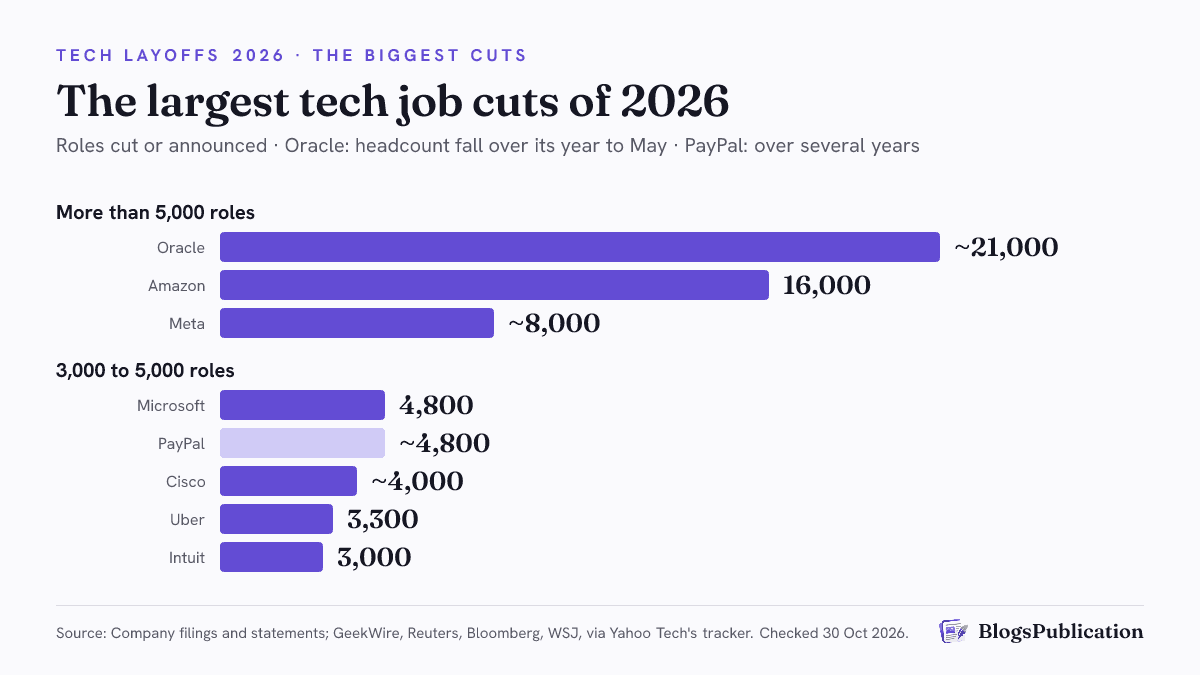
Tech Layoffs 2026: The Biggest Cuts So Far, and What Companies Said About AI
By early August, more tech workers had been laid off in 2026 than in the whole of 2025. The biggest cuts — Oracle, Amazon, Meta, Microsoft, PayPal, Cisco — what each company said about why, what happened in October, and what to do if it happens to you.
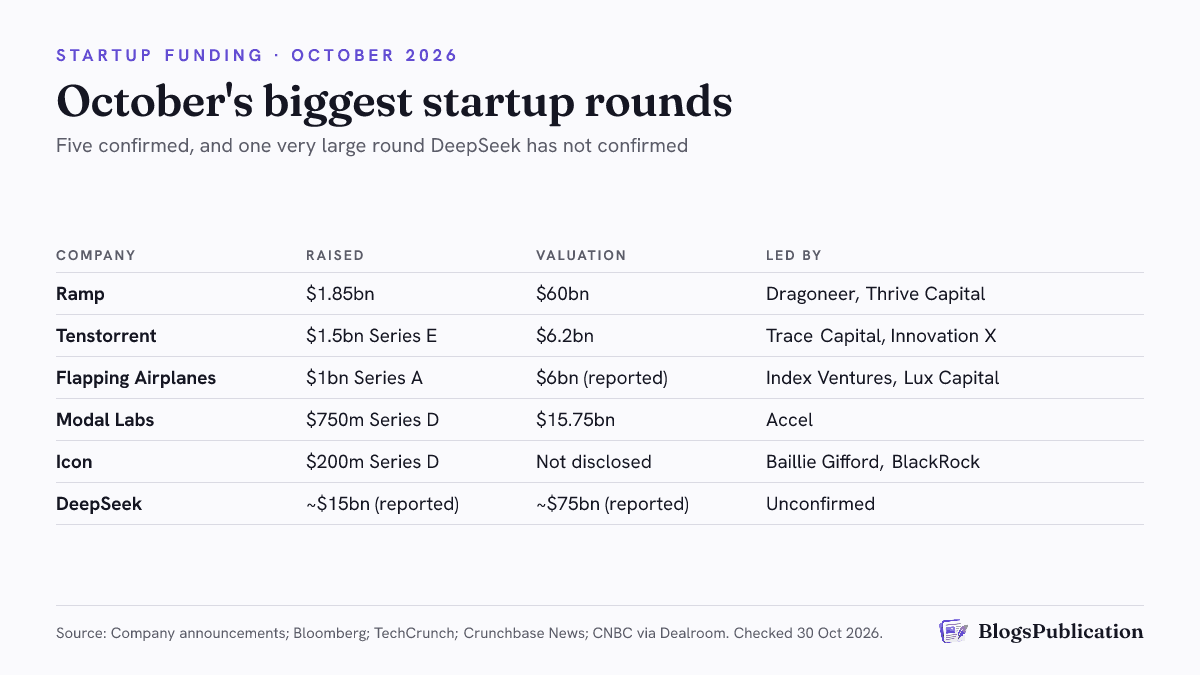
Startup Funding News, October 2026: The Biggest Rounds and What They Tell Us
Ramp raised $1.85 billion at a $60 billion valuation, Tenstorrent $1.5 billion, Flapping Airplanes a $1 billion Series A and Modal Labs $750 million. October's biggest startup rounds, sourced and checked, with the Q3 numbers behind them and what they mean if you are not raising a billion.
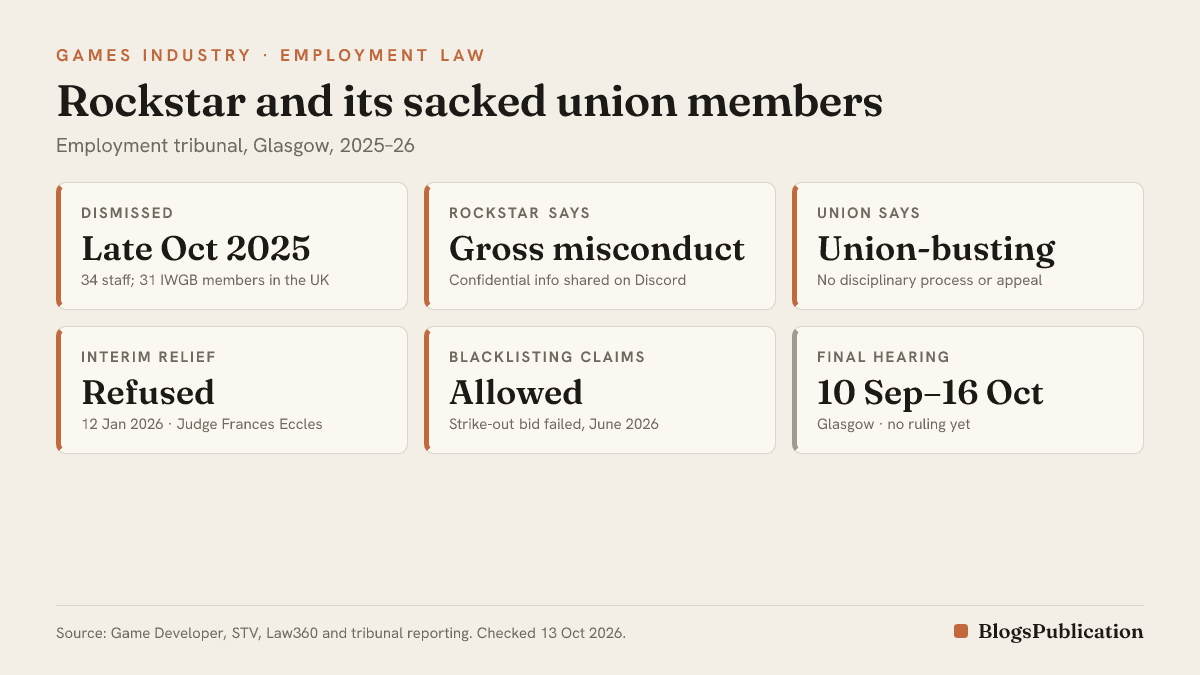
Rockstar's Union Tribunal: What the Judge Must Decide, and When a Ruling Comes
The Glasgow tribunal over Rockstar's dismissal of 31 union members is due to finish this week. What the workers claim, Rockstar's defence, the two rulings so far, the law the judge applies, and why a decision probably won't come before GTA 6 launches.
EA Went Private in the Largest Buyout on Record. The Debt Is the Story
Electronic Arts left the stock market on 4 August 2026 in a $55 billion deal. About $18 billion of borrowing came with it, and the annual interest on that debt is large enough to reshape what EA makes.